Report – November weekend course in the Netherlands.

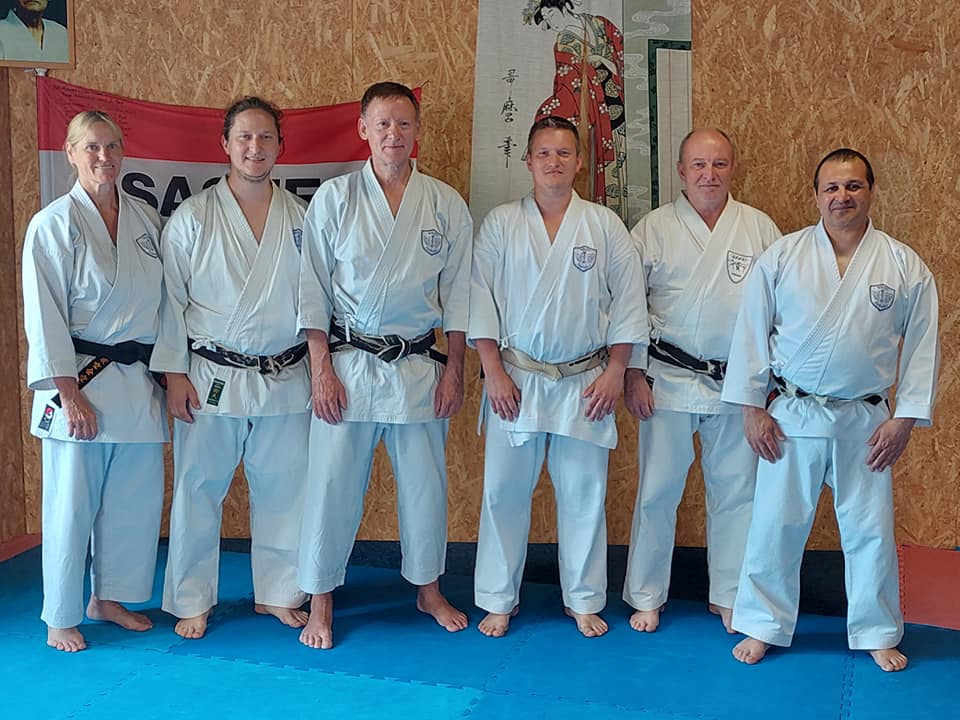
It has always been a huge pleasure and an honour to be invited to teach over in Holland. A terrific experience on many levels, not least because of the friendships and personal connections I have developed over the years. And it’s not just the same faces; this time, as before, I meet new people (not always Wado practitioners) and it becomes a two-way thing, fuelled by shared passions for martial arts training and the joy of working together in the Dojo shoulder to shoulder.

Hosts Martijn Schelen and Astrid de Vries have their organisation and promotion skills honed to a fine edged craft; I couldn’t have asked for more. As before, everything was totally frictionless.

Across three days (nine hours) of training we aimed to dig deeply into aspects of Wado karate, which was kicked off on Friday with a granular exploration of the kata Seishan. I have to say that this kata has been ‘flavour of the month’ in Shikukai circles for at least the last four months, maybe even longer. Our chief instructor, Sugasawa Sensei has been forensically dissecting Seishan in his face-to-face teaching and his Zoom sessions. Sensei’s understanding of the kata is largely inspired by his personal experiences particularly with the late second grandmaster of Wado Ryu. So, I felt it was my responsibility to share Sensei’s revelations as best I could and try to represent his teachings.

The reality was that the two hours on the Friday were nowhere near enough time to do full justice to Seishan, but I gambled that it was better to be ambitious with content than to scrimp and make people feel they had been short-changed. As it was, it seemed to work.

Seishan was the springboard for the remaining two days. Aspects found within the kata kept reappearing, often in unexpected ways. This underlined what a joined-up system Wado is, with symbiotic connections revealing themselves, reinforcing core principles, and all of it applicable to fighting.

I know I have mentioned before what a pleasure it is to conduct a course in Martijn’s beautifully designed Dojo, but the structure and ambiance really does add to the whole experience. Although the numbers attending made it quite tight for space, the room is airy and flooded with light.

The students attending were a mixture, not all from Martijn’s own Dojo, but also from further afield. For example; it is always great to meet up with Jerry Smit, a very senior and experienced Wado instructor who travelled down from Amsterdam, who I have known for a number of years now. Also present was a highly ranked Shotokan Sensei; this is his second time training on a Shikukai course, but on this occasion, he was able to run a comparison between Wado’s Seishan and Shotokan’s Hangetsu. But we also had kyu grade students who seemed to enjoy the windows opening up in front of them and to have a chance to work with some very able and skilful seniors and glimpse the bigger picture of Wado.

On the Saturday we explored Pinan Shodan and linked this to specific Wado body manipulations and, as mentioned, references to Seishan popped up, and once you’ve seen it it’s like finding a key to a lock, in fact several locks!

When we opened those doors we were able to move into Wado paired kata and dig into the kumite gata and kihon gumite.

The Sunday training unpacked aspects of Nagasu as applied in defence and deflection; this took us into more paired kata, building up from ippon gumite from the Shikukai syllabus into more advanced kumite.

Saturday evening gave us the chance to unwind and get together socially in a local restaurant.

Overall, this was a very successful weekend. Martijn and I are already sorting our calendars for the next event in the Netherlands and have pencilled a date in for March 2023 – watch this space.

Also, regarding events; across the weekend there was a lot of interest in our UK Shikukai Winter Course. It is looking rather like a Dutch invasion! Sugasawa Sensei and Shikukai senior instructors will be conducting training across the weekend of the 11th and 12th February (with extra opportunities to train). This will be in Essex which is very handy for connections to Stansted Airport. Please let us know if you are interested.

As with the previous Holland course, I will publish a set of technical notes to support the training we did over the weekend. This will be in blog post form and may be of interest to the wider reader and Wado enthusiast.

A huge thank you to Martijn and Astrid and everyone at Kenkokai and to my fellow traveller from the UK, Sue Dodd.

Tim Shaw

Report – Shikukai Autumn Course 2022.

It was a real privilege to be able attend and be a part of the Shikukai Karate International Autumn Course of October 2022. This established annual course had been held on Zoom in 2021 due to Covid restrictions and was long awaited by Shikukai students from across the country.

The course was presided over by Sugasawa Sensei 7th Dan Renshi and we are indebted to his insightful wisdom and input throughout the weekend.

The course was hosted by Sensei Carol Chatterton 6th Dan (Kiku Wa Jyuku) and led by Sensei Steve Rawson 7th Dan and Sensei Pam Rawson 7th Dan.

Sugasawa Sensei opened the event by welcoming us back to the dojo. Sensei referred to the absence of a senior Shikukai Instructor who is facing some health issues. He also recognised the fantastic efforts of Steve Rawson in recently completing an Ironman 70.3 which raised over £1,000 for a related charity. Steve modestly replied, “My battle was over in 7 hour 20 mins, but our friend’s will be considerably longer”. Our collective thoughts are with the Instructor and his family.

After a hearty warm up by Carol Sensei, Steve and Pam Senseis introduced the theme for the two days. “Chi Kou Gou Itsu” – Awareness comes only through practice.

For the first session we worked as one to ensure that the foundations of our Wado principles were developing in the correct way. Specific combinations and drills were shown and practised. These enabled us to think about and refine our own techniques and take inspiration back into our own practice and our own dojos.

We then moved to a paired exercise with a variety of kicks. Safe to say a ‘good sweat’ was had by all.

After a short break we moved on to Kata which sequentially built a combination employing the opening few techniques of three Pinan Kata. Not only was this new but it was linear rather than transitioning to left then right as we would in the Kata. We could focus now on each technique in a ‘new’ environment.

We then formed into three groups: 3rd Dan and above worked on Seishan Kata with Steve Sensei, while 3rd kyu to 2nd Dan were with Pam Sensei who took them through Bassai Kata. 4th kyu and below were with Carol Sensei. Sugasawa Sensei oversaw the three groups adding his invaluable input.

The final session saw the introduction of Kumite No Ura and its relationship with Kihon Gumite.

Many reconvened that evening for a meal at a local Italian restaurant.

Day two began with a warm up from Carol Sensei. Steve and Pam Sensei then built a physically and mentally challenging sequence of combination techniques. Most we were very familiar with but in an unfamiliar sequence, some techniques were less familiar such as Furiken. This culminated in a single combination where we shifted between 20 techniques being delivered at 12, 6, 9 then 3 on the clock face. More good sweat.

After a short break we continued the previous day’s Pinan Kata sequence adding the remaining two.

We then formed into 2 groups: 3rd kyu and above worked on Chinto Kata with Steve Sensei whilst 4th kyu and below were with Pam Sensei and were drilled through the 3rd kyu syllabus.

The final session of the day explored Kihon Gumite 5 and 8 for all students.

Throughout the course students were able to see how Kihon, Kata and Kumite flowed seamlessly together. It was a truly inspiring course where students of all grades and experience were encouraged to challenge themselves.

Everything was catered for, from a warm welcome at the door, time to re acquaint with Shikukai students/friends from afar, progressive and thoughtfully planned and well delivered training sessions, ‘homework’ to take away and think about in our own dojos. There was also time to relax and enjoy being part of the Shikukai family.

Sensei closed the event by thanking Carol Sensei and Kiku Wa Jyuku for an excellent job of hosting, also Steve and Pam Senseis for their instruction. He promoted being more positive in our everyday language, to keep healthy, and then wished everyone a safe journey home.

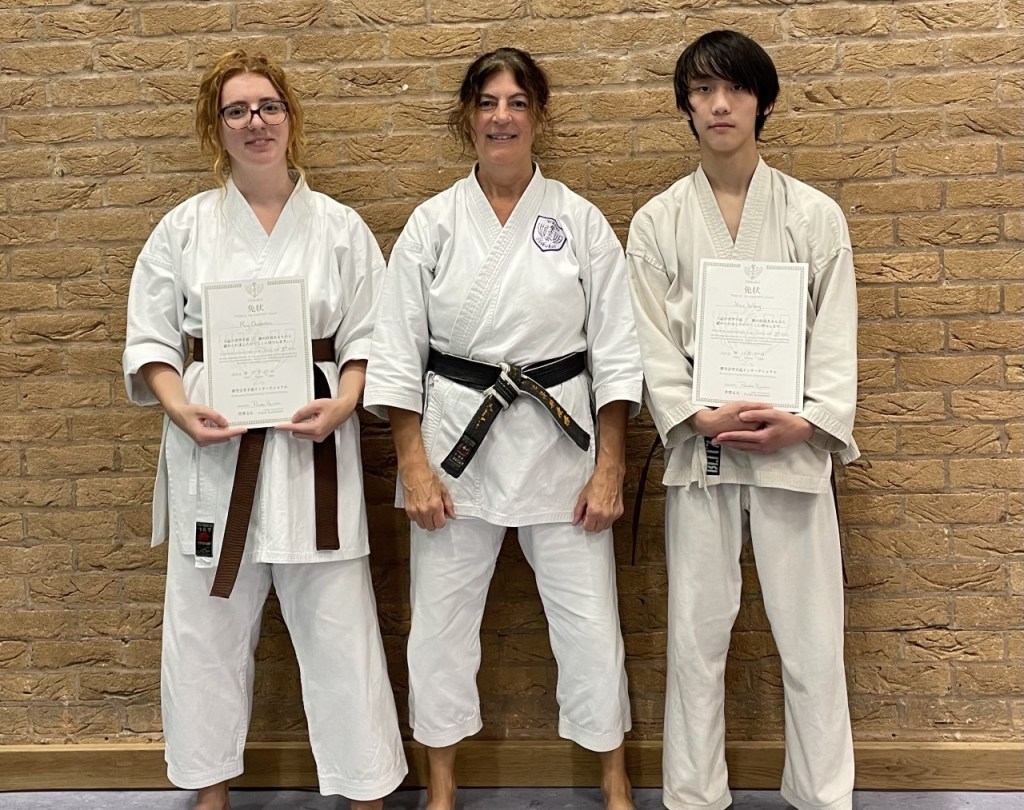
Two Kiku Wa Jyuku students Meg Chatterton and Alex Wong successfully graded to 3rd Kyu.

Joint report by

Earle Thomas 2nd Dan and Sue Dodd 2nd Dan

Report – Wado Karate Chertsey – Summer Camp August 2022

With the help of Sensei Richard Barham 6th Dan, we held our first summer camp at the beginning of August. Over five days, the 2-hour sessions provided an opportunity for students to have some intense training which allowed them to improve their karate in a very short period, learn new techniques, and have some fun on hot summer days.

Although the group was small, we were able to split between green belts and red belts, which allowed us to provide a programme over the week and meant we could give more personal attention to each student.

Between myself and Sensei we conducted sessions on Kihon, Renketsu-Dosa and Kata as well as pad work. The variety was excellent in keeping the youngsters interested, and each day was split into three sessions, with warm up games and drink breaks, as temperatures reached the mid 30’s. Sensei took the green belts through Pinan Godan over a couple of sessions, and our keen-eyed photographer snapped a good example of him demonstrating the jump! Amongst the syllabus work we went through; we also took time to introduce students to Ukemi (break fall). The venue we rented (Jubilee High School in Addlestone) had some good mats to try this on, but as it was only an introduction, we focussed on soft falls, from kneeling, including forwards, backwards and sideways rolling to a guard position working on keeping our hands up. Demonstrations on how this can then be used to defend from the floor were given, and the intention is to do more of these kinds of sessions to help build up confidence and ability.

One of the common threads through the week was the use of the pads, this was partly because the kids enjoy the freedom of being able to strike a target, but also the focus was on accuracy and balance ahead of power. Sensei used the pads to help our young students understand the starting principles of jiyu kumite, and the idea that when attacking, the opponent will respond. It was encouraging to start to see students realise the importance of staying focussed during these drills and see their reaction times improve as well. At the end of the week, and to burn off any remaining energy, we did a kicking competition whereby points were awarded for chudan (5pts) and jodan (10pts) keri waza, within a 30 second period. Thankfully I didn’t disgrace myself compared to the kids!

The week culminated with two of our red belt students passing their 8th kyu grade. Being twins, they are always competitive, and it was great to see them both do so well. We’re hopeful that the summer camp will act as a starting point for more training like this, to complement the weekly classes and ensure during holiday periods students can continue with their karate journey.

Another positive from the week was being able to design and print some Shikukai T-Shirts. Using the new logo which designer Frank Parry has assisted with, we produced a small batch which the camp attendees were presented with.

My thanks to Richard Barham Sensei for his support in the weeks leading up to the course, and for his help at the camp itself.

Colin Batchelor

Report – Shikukai Junior Competition.

The long awaited Shikukai children’s competition was held at the beginning of July at the Olympiad Centre in Chippenham, Wiltshire.

The well planned day was a tremendous success. It enabled children from different Shikukai clubs to come together to train and compete as one.

It was the first time that many of our children from Chelmsford had entered a competition and certainly the furthest that they had travelled for one. After a three hour drive we were met and made to feel welcome by our hosts Sensei Carol and her team. Our children and parents were put at ease straight away

As we walked into the competition arena we were greeted by the sight of the matted area, seating for parents and tables set with medals and trophies.

The day began with a joint warm up and kata session led by Sensei Steve and Sensei Pam Rawson. This was perfect planning as the children mixed together straight away and were able to train side by side. A brief breakdown of the rules and expectations for the day followed and then we were soon starting the day with the first competition:

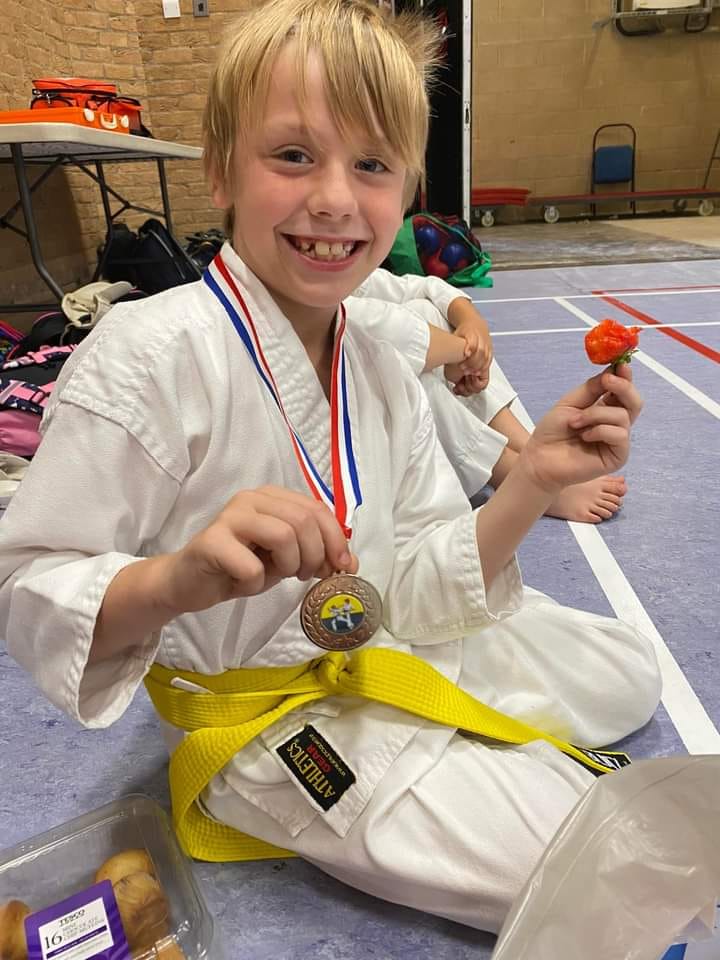
Punch and kick the pad – Children who took part in this event showed real spirit and determination. They were cheered on by parents which added to the atmosphere. All of the children in this category were awarded a medal for their stamina and determination.

At the end of the session it was lovely to see a good mixture of children coming away with trophies:

PUNCH AND KICK THE PAD  6 – 8 Years
1st      Matthew Game – Chelmsford
2nd     Rosie Cornwell – Chelmsford
3rd     Tommy Lyons-Wilkes – Chelmsford


PUNCH AND KICK THE PAD 9 – 11 Years
1st     Hannah Phillips – Chippenham
2nd     Oliver Cornwell – Chelmsford
3rd     Molly Mclean – Chippenham

The second event was Kata. Here the children were asked to perform twice in front of judges from Weymouth, Chertsey, Chippenham and Chelmsford. There were a variety of Katas on display ranging from Kihon Kata to Kushanku. Judges were particularly impressed with the stances and focus of some students.

KATA 6 – 10 Years
1st     Oliver Cornwell – Chelmsford
2nd    Molly Mclean – Chippenham
3rd     Miriam Springett – Chelmsford
KATA 11 – 16 Years
1st     Christopher Coates-Jones – Chelmsford
2nd     Archie Warren – Weymouth
3rd     Henry Seeman – Chippenham

The final category was Kumite.

All of the children who took part fought with integrity and purpose. As we neared the end of the day it was a good opportunity for our children to learn hints and tips by watching the older children perform.

BOYS KUMITE 8 – 9 Years
1st     Alfie Durrant – Chelmsford
2nd     Oliver Cornwell – Chelmsford
3rd     Phin Mulley – Chippenham

GIRLS KUMITE 9 -10 Years
1st     Scarlet Sweet – Chippenham
2nd     Hannah Phillips – Chippenham
3rd     Molly Mclean – Chippenham and Miriam Springett – Chelmsford   (joint)

BOYS KUMITE 10 -12 Years
1st     William Phillips – Chippenham
2nd     Chris Coates-Jones – Chelmsford
3rd     Noah Ladd – Chippenham
4th     Harry Taylor – Chippenham

BOYS KUMITE 14 – 16 Years
1st     Archie Warren – Weymouth
2nd     Lewis Higginson – Weymouth
3rd     Alex Wong – Chippenham
4th     Henry Seeman – Chippenham

All of the children were a real credit to their instructors, their families and to Shikukai.

They have started to make new friends and to become a family of their own.

We are really looking forward to meeting again.

Many thanks to Sensei Carol and her team, to Sensei Steve Rawson, Sensei Pam Rawson and Sensei Richard Barham for their time and effort as without this it wouldn’t have been possible.

You have restarted something special.

I’ll leave you with a few comments:

It was an absolute pleasure for Steve & I to oversee the running of such an inspirational event. The youngsters were an absolute credit to their parents and the Shikukai family.’ Sensei Pam Rawson

It was the best day ever’ – Tommy

‘I didn’t win, but I loved it and made a new friend ‘ – Connie

What a lovely atmosphere. All of the children from all of the clubs put so much effort into everything and were so respectful’ – Parent

‘I was scared at first, but I did it’ – Harry

Sue Dodd 2nd Dan Instructor at Shouwa Jyuku Kodomo (Chelmsford).

Report by Richard Barham – Budapest weekend course with Tim Shaw Sensei.

Early in the morning of 3 June, I set off to Heathrow not knowing if my flight to Budapest would be running, and more importantly whether Tim Shaw Sensei accompanied by Sue Dodd would also get to have their flight from Stanstead impeded.

Despite the media hype, we all arrived pretty much on schedule and were greeted by the local host Atilla Jakab.

Ahead of us were three eagerly anticipated days of training at GENKI, the Shikukai group in Hungary; based at Isaszeg, twenty-four miles east of Budapest.

With little time to adjust to the 30°C temperatures, the first session was upon us. GENKI are very fortunate to have their own dedicated dojo, and it is an ideal space for karate training. There is something about the place that makes it feel special. Perhaps it is the collected hours of training that the local students have amassed? Ahead of the training I was pleasantly surprised to be greeted by several of the younger student, who made a special effort to welcome each of us, as well as pay respect to the local seniors. It really showed the character that resident instructors, brothers Attila and Adam and father Laszlo had instilled in their students.

Introductions and re-acquaintances over, we got into the first training session. Tim Shaw Sensei explained from the outset that the theme for the next three days was to be aware of the role of each part of the body in executing techniques, how the different parts were connected, and how the whole ensemble makes for a single effective outcome. Work on these aspects started even in the warm-up – maybe warm-up is the wrong choice of words – it was still 30°C outside.

Now, I am not going into detail of every aspect of the training, suffice to say that over the three days we practiced Kihon, Kata and Kumite, mostly in a very joined-up fashion, where techniques practiced as solo Kihon were then worked in pairs, and where the same principles were also picked out in Pinan Sandan, the featured kata for the weekend. Sensei clearly has a plan for the weekend, and it was delivered flawlessly from my perspective; clearly explained, logical and inspiring. To me, it seemed there were intentional gaps in the explanation, or at least some threads left intentionally open-ended, for the students to connect the dots. There was certainly some of that going on, which made for a very satisfying learning experience. Sensei’s finale was to have the Kyu-grade students work on Goshin-Ho, with some very elaborate escape and control methods that had the students beaming, and the Dan-grades looking on wishing they could have a go!

This was my first visit to the GENKI dojo, but it will certainly not be my last. I thoroughly enjoyed the whole experience. The training was of course, first class and enlightening, but the hospitality of Atilla, Adam and Laszlo has to be mentioned. They were on-hand from start to finish, and worked extremely hard all weekend to ensure that we had to think of nothing, from arrival at the airport to departure. Transfers to and from the dojo, food and social arrangements were all taken care of. They even dismantled part of the dojo to recover someone’s phone that was dropped out of reach! My personal thanks to them for making the trip such a pleasurable experience, and I can’t wait for the next opportunity to go back.

Foreign travel is rather uncertain at the moment, but this weekend has shown that it does work most of the time. Hopefully the situation will only improve, and I thoroughly recommend giving some thought to joining this course in the future if you have the chance, or indeed any of the other overseas courses in the Shikukai calendar. I am certain the organisers will appreciate the efforts to attend, as I am certain that you will have a great experience.

Richard Barham 6th Dan

Link to the Genki Dojo website.

Report – June Combat Lab Weymouth.

The third Shikukai Kumite based training held at The Combat Lab Weymouth this year was another great success. It built upon previous sessions where students had worked with bags to improve their awareness of distance and timing.

During the intense two hour training, students from a variety of Shikukai clubs worked together to focus on controlling their attack for self-protection and for offence. This involved working in pairs for strength training, stretching and with hand held pads to increase fast and fluid movements. This developed an understanding of Maai No Kakehiki. 

Rather than using physical strength alone, students were encouraged to maintain body discipline while performing certain techniques.

Many thanks to Sensei Steve and Sensei Pam Rawson for a very well planned and executed session: 

Sue Dodd 2nd Dan 

Awesome, so good to work so well together”

“This was such a great session, engaging brain and body, sweaty and interactive, great fun, can’t wait for the next one”

“Lucky to have Shikukai as a family to work and train so hard and so well with”

Report – Shikukai Spring Course, Portland Dorset.

Little did we know when we held our Spring Course in Portland in May 2019 that it would be the last one until 2022. It was therefore especially rewarding to welcome Sensei, instructors and students back to The Osprey to train together once more, including a contingent from Norway with their Instructor Bob Wymer Sensei and Andrew Genery and his student Paul, from Kishin Karate Academy, Doncaster.

Friday evening’s session began with a short warm up by Pam Rawson Sensei then moved on to basics with Steve Rawson Sensei leading the session and Sensei Sugasawa, Steve Chamberlain Sensei and Pam Rawson keeping a close eye on students’ technique. Sensei stressed the importance of “Okori Taru Tokoro” – the origin of the movement. The second hour was devoted to simple kumite based drills, lead by Steve & Pam, incorporating basic Wado principles. Steve Chamberlain was on hand with his “Bokken” to ensure the seniors were moving correctly. Everyone was then invited to take the short stroll along the Marina for light refreshment at “The Boat that Rocks.”

Saturday saw the biggest numbers with around 40 people training. Sensei Sugasawa began the session by leading a minute’s silence (Mokuto) in memory of Suzanne Genery, Andrew’s sister, who sadly passed away ten years ago to the day. He then presented Dan Certificates to those who had been successful over the past two years.

Tim Shaw Sensei took the warm up then the class was split into grades. Steve Chamberlain and Tim took the Seniors for Kihon, working on Junzuki and Junzuki No Tsukkomi. Steve & Pam took the white & green belts focussing on the transition between Junzuki and Gyakuzuki. After an hour, the groups changed with Tim and Sensei leading the Senior grades for Bassai Kata. Tim explained the comparison with working on a classic car – ie it is ever so easy to work on the chassis and bodywork, but the real work is what happens under the bonnet. Steve Rawson took the 1st – 3rd Dans for Jion while Pam took the 3rd – 1st Kyus for Nai Hanchi and Kushanku. Steve Chamberlain took the Green belts for Pinan Sandan. Richard Barham Sensei worked with the White belts, focussing on Kihon Kata and developing into Pinan Nidan. He worked through fundamental aspects such as stance and structure as well as explaining Mudana Ugoki relating to the turns into Gedan Harai Uke. His students then took advantage of the matted area to practise their chosen competition kata. After a short break Pairworks were covered, with Steve & Pam taking the seniors for Kihon Gumite 6,7 and 8. Tim took the brown belts and 1st Dans for Kihon Gumite Ipponme, with Steve Chamberlain working with the Green belts and Carol Chatterton Sensei taking the white belts through their syllabus pairwork.

Saturday night we were back at The Gurkha Restaurant which gave everyone the chance to mingle and meet friends and family.

Sunday’s warm up was taken by Steve Rawson, then the group was again split into grades. This time the seniors were taken by Steve & Pam, again focussing on the transition between Junzuki and Gyakuzuki but this time incorporating Keri. Sensei stressed the importance of correct weight on the back foot. The Junior grades were taken by Tim and Steve Chamberlain.

The senior Kata session this time was led by Sensei and Steve Chamberlain who worked on Ni Sei Shi Kata. Pam lead the 1st – 3rd Dans with Chinto, while Steve Rawson covered Rohai for the Brown belts and Tim did Pinan Shodan with the Junior Grades. After the break Tim and Steve Rawson took the 2nd Dans and above to the matted area where they practised some Tanto Dori and Kumite Gata. Steve Chamberlain took the 3rd Kyu – 1st Dan group with Richard & Rob Selby Sensei working with the Junior grades, emphasising the importance of distance and timing as well as correct defensive action involving Uke Nagashi, Harai and Sogu to avoid direct impact with the opponent’s attack. This evolved into Kumite Kata type movement, attacking and defending from Hanmi Gamae and applying the same defensive actions from Nihon Gumite (Gaiwan Uke). San Mi Ittai was also introduced.

Monday’s warm up was taken by Steve Chamberlain who had prewarned everyone to bring towels as we were going to be lying on the cold floor for some time! The Senior Kihon session was taken by Tim and Steve Chamberlain, focussing on detailed aspects of Renketsu Dosa from the early part of the syllabus. Carol & Richard were then able to concentrate on grading work for those taking a grade later in the morning, including coverage of Pinan Shodan and Yondan.

After a short break, the final session was taken by Steve & Pam who revisited the Kumite drills from Friday night, taking them further with defences and practising them in pairs.

The Kyu Grading examination was held within the session and taken by Tim and Richard.

The following students were successful:

Brian Glover (Mushin Jyuku) 1st Kyu

Andrew Skelton (Kiku Wa Jyuku) 2nd Kyu

Lewis Selby (Mushin Jyuku) 3rd Kyu

Will Doble (Shouwa Jyuku) 8th Kyu

All too soon, the four days had come to an end. Sensei thanked everyone for attending and hoped they had all taken something away to further their training.

Next year’s Spring Course will be held at the same venue, but revert back to the second May Bank Holiday – Friday 26th/Saturday 27th/Sunday 28th/Monday 29th May 2023.

6th May 2022

Pam Rawson 7th Dan

Report – April Instructor’s Course, Tanto Dori.

This was always going to be a challenging agenda; an instructor’s course with Tanto Dori (knife defence) as its main focus!

Fortunately, Sugasawa Sensei gave it his blessing and allowed me scope to present a three-hour training session dedicated to this much maligned, much misunderstood aspect of the fuller Wado curriculum.

Three hours was barely enough.

Let me explain how I chose to design it…

First of all, I had to create a case for Tanto Dori.

I wanted to present it not as some kind of museum-piece (and certainly not as something that stands apart from the wider Wado curriculum).

As such, my opening statements first of all, tagged Tanto Dori as distinctly ‘kata’, NOT choregraphed knife fighting, or (heaven forbid) ‘self-defence’, this is not how the pedagogy works. The wider agenda, of course, has personal protection as it’s ultimate goal, but that’s way down the line, Wado is far more of a sophisticated entity than to pander to mere expedience as it’s driving force, oh no, the methodology is complex and of a much higher order.

So, I presented Tanto Dori as Principle-driven.

Essentially, you cannot access Tanto Dori without anchoring it securely in your core Wado Principles. If any of those key elements are missing then the practice of Tanto Dori becomes empty and meaningless; this is why so often it just appears as a curiosity, an anachronism, or, as is often seen, a sensationalistic ‘performance’ ramped up as a crowd pleaser and (probably) rightly criticised and called out as such.

The content.

We started out with a series of solo drills, which were designed to explore body shifting relevant to the kata we were to later engage with.

The opening techniques featured the established protocols of handling the blade and the nuances of the relationship between Tori and Uke.

The starting technique was ‘Hiki Tate’, this established the element of Tsuki Taro Tokoro, essential to timing and the control of the opponent.

The second technique was ‘Ude Garami’, which introduced the timing necessary for Okuri Taro Tokoro and then involved the locking up of Uke’s whole shoulder process, before leading to his structural downfall.

Next, Harai Uke was deployed against a chudan thrust, leading to ‘Kinu Kuguri Dori’. This was useful in that it emphasised the need to keep Uke perpetually off-balance and never let him recover.

This was followed by ‘Kiri Oroshi’ which lead to ‘Kote Nage Dori’, a vicious demolition of Uke’s attack, which delivered a series of devastating pinpoint attacks designed to take Uke apart into his weakest line.

We then moved into the infamous left-handed deception; the attack and timing of this sneaky thrust puts a challenge on both Uke and Tori.

I followed this with a technique (kata) that was not a part of our normal tradition but emphasised what can happen when Tori is a skilled knife-man, where Uke attacks with a deceptive left-handed move and Tori deploys a hidden multi-point slice and dice which moves from wrist to jugular, follows the line of Kesa-giri and then pierces the lower abdomen supported by an ‘Aiuchi-style’ demolition which in turn uproots Uke and finalised a chain of events that efficiently concludes the encounter.

The last technique was an Idori-style defence against another left-handed thrust.

To finish the whole session off, the brief was a freestyle test; an opportunity to ‘fail’ and to put into perspective the strengths and weaknesses of what can be extracted from the kata of Tanto Dori.

I then added an extra challenge which put Tori into a virtually impossible position, again another opportunity to explore the outermost boundaries of what is possible.

Sugasawa Sensei contributed with adjustments and subtle direction, which emphasised issues of balance and position and the relationship between Tori and Uke. He also advised individual students on how to ensure that Uke suffered the maximum of disruption which preceded their demolition and ultimate downfall.

My thanks to Richard Barham for organising the venue and coordinating everything, and to Richard and Linda for the excellent post-training lunch and refreshments. You can’t get more civilised than that.

Tim Shaw

Report – March Kumite-based training in Weymouth.

Following on from the successful introductory kumite based training in January, an additional session was held in March 2022.

Shikukai students from Weymouth, Chippenham, Chelmsford and Exmouth joined together to learn and enhance their understanding of the Wado principles of Kumite.

The action-packed two hours was led by Sensei Steve and Sensei Pam Rawson and involved kihon drills, bag and pair work. 

Throughout the session the students’ understanding of the use of distance and timing (Ma-ai and Ma) was constantly challenged. 

After a stretch and warm up they began with focussed kihon drills that they would later use with the bags and then with a partner. Bag work enabled the students to increase the sharpness and accuracy of their techniques whilst pair work helped them gain a better understanding of the underlying Wado principles. 

Many thanks to the Senseis for the diligent planning, preparation and delivery of the session and to all of the students from the attending Shikukai clubs for the positive team atmosphere and support of each other.

Sue Dodd
2nd Dan

Report – March, Holland course with Tim Shaw Sensei.

I have been travelling across to seminars in the Netherlands for so many years now, initially to accompany Sugasawa Sensei, but eventually on my own, all down to the enterprising initiatives of the growing nucleus of Shikukai members in Holland.

The course organisation has been under the consistent captaincy of Martijn Schelen, who has always taken his personal inspiration from the teachings of Sugasawa Sensei as Shikukai chief instructor.

But this particular course had a special significance attached to it, as it is the first Shikukai course outside of the UK since the beginning of the pandemic (my last course in Holland was two years ago when we were on the brink of closing everything down and my Sunday night return to Stansted airport was marked by the image of an airport turned into a ghost town).

This time, despite the threat of Byzantine bureaucracy necessary to cross international borders, I was relieved and excited to be back on the seminar circuit. Fortunately, everything went smoothly.

The Dutch students I met told me how they had really been feeling the lack of seminars and events over the last few years, and here we were, back in the Dojo once again.

The training had been organised to spread over three days and was based in Martijn Shelen’s beautifully designed Dojo. I had always appreciated how Martijn had incorporated clever and subtle design features into the available space and had managed to strike the right balance between personalising the interior with idiosyncratic details, while creating the formality of a modern, uncluttered Japanese Dojo all without the need to add any unnecessary ‘Japanesque’ frills (something all too often seen in modern western attempts at Japanese interiors).

I was pleasantly surprised by the attendance; a good mixture of Martijn’s regular Dojo members and people who had travelled from much further afield, and in one case a senior instructor from Shotokan; but also, a healthy showing from kyu grades who were eager for the experience and to explore what the seniors were tapping into. I felt the need to be particularly watchful and to give them as much guidance as I could, because it is the kyu grades who are the long-term future of Wado karate.

Over the three days training I had programmed in a couple of underpinning themes; one was to understand how the whole body contributes to the execution of techniques and to get to actually feel how that mechanism works. The other was to develop/encourage a mindset that focussed on why we do things in certain ways; what do we gain from it? This was delivered through exploration of specific individual techniques and their methods of delivery, as well as kata and carefully selected Wado pairs work.

(I have published a separate blog post on the Shouwa Jyuku website as a series of supporting notes for the students who attended the course. Link).

We totalled eight hours of training over the weekend, but after training the conversations continued (as they always do).

Superb organisation by Martijn and Astrid, my thanks to both of them and to all the Dutch (and Belgian) trainees, a great opportunity to renew friendships and work shoulder to shoulder.

Watch this space for another Holland course later in the year.

Tim Shaw