Report – April Instructor’s Course, Tanto Dori.

This was always going to be a challenging agenda; an instructor’s course with Tanto Dori (knife defence) as its main focus!

Fortunately, Sugasawa Sensei gave it his blessing and allowed me scope to present a three-hour training session dedicated to this much maligned, much misunderstood aspect of the fuller Wado curriculum.

Three hours was barely enough.

Let me explain how I chose to design it…

First of all, I had to create a case for Tanto Dori.

I wanted to present it not as some kind of museum-piece (and certainly not as something that stands apart from the wider Wado curriculum).

As such, my opening statements first of all, tagged Tanto Dori as distinctly ‘kata’, NOT choregraphed knife fighting, or (heaven forbid) ‘self-defence’, this is not how the pedagogy works. The wider agenda, of course, has personal protection as it’s ultimate goal, but that’s way down the line, Wado is far more of a sophisticated entity than to pander to mere expedience as it’s driving force, oh no, the methodology is complex and of a much higher order.

So, I presented Tanto Dori as Principle-driven.

Essentially, you cannot access Tanto Dori without anchoring it securely in your core Wado Principles. If any of those key elements are missing then the practice of Tanto Dori becomes empty and meaningless; this is why so often it just appears as a curiosity, an anachronism, or, as is often seen, a sensationalistic ‘performance’ ramped up as a crowd pleaser and (probably) rightly criticised and called out as such.

The content.

We started out with a series of solo drills, which were designed to explore body shifting relevant to the kata we were to later engage with.

The opening techniques featured the established protocols of handling the blade and the nuances of the relationship between Tori and Uke.

The starting technique was ‘Hiki Tate’, this established the element of Tsuki Taro Tokoro, essential to timing and the control of the opponent.

The second technique was ‘Ude Garami’, which introduced the timing necessary for Okuri Taro Tokoro and then involved the locking up of Uke’s whole shoulder process, before leading to his structural downfall.

Next, Harai Uke was deployed against a chudan thrust, leading to ‘Kinu Kuguri Dori’. This was useful in that it emphasised the need to keep Uke perpetually off-balance and never let him recover.

This was followed by ‘Kiri Oroshi’ which lead to ‘Kote Nage Dori’, a vicious demolition of Uke’s attack, which delivered a series of devastating pinpoint attacks designed to take Uke apart into his weakest line.

We then moved into the infamous left-handed deception; the attack and timing of this sneaky thrust puts a challenge on both Uke and Tori.

I followed this with a technique (kata) that was not a part of our normal tradition but emphasised what can happen when Tori is a skilled knife-man, where Uke attacks with a deceptive left-handed move and Tori deploys a hidden multi-point slice and dice which moves from wrist to jugular, follows the line of Kesa-giri and then pierces the lower abdomen supported by an ‘Aiuchi-style’ demolition which in turn uproots Uke and finalised a chain of events that efficiently concludes the encounter.

The last technique was an Idori-style defence against another left-handed thrust.

To finish the whole session off, the brief was a freestyle test; an opportunity to ‘fail’ and to put into perspective the strengths and weaknesses of what can be extracted from the kata of Tanto Dori.

I then added an extra challenge which put Tori into a virtually impossible position, again another opportunity to explore the outermost boundaries of what is possible.

Sugasawa Sensei contributed with adjustments and subtle direction, which emphasised issues of balance and position and the relationship between Tori and Uke. He also advised individual students on how to ensure that Uke suffered the maximum of disruption which preceded their demolition and ultimate downfall.

My thanks to Richard Barham for organising the venue and coordinating everything, and to Richard and Linda for the excellent post-training lunch and refreshments. You can’t get more civilised than that.

Tim Shaw

Report – March Kumite-based training in Weymouth.

Following on from the successful introductory kumite based training in January, an additional session was held in March 2022.

Shikukai students from Weymouth, Chippenham, Chelmsford and Exmouth joined together to learn and enhance their understanding of the Wado principles of Kumite.

The action-packed two hours was led by Sensei Steve and Sensei Pam Rawson and involved kihon drills, bag and pair work. 

Throughout the session the students’ understanding of the use of distance and timing (Ma-ai and Ma) was constantly challenged. 

After a stretch and warm up they began with focussed kihon drills that they would later use with the bags and then with a partner. Bag work enabled the students to increase the sharpness and accuracy of their techniques whilst pair work helped them gain a better understanding of the underlying Wado principles. 

Many thanks to the Senseis for the diligent planning, preparation and delivery of the session and to all of the students from the attending Shikukai clubs for the positive team atmosphere and support of each other.

Sue Dodd
2nd Dan

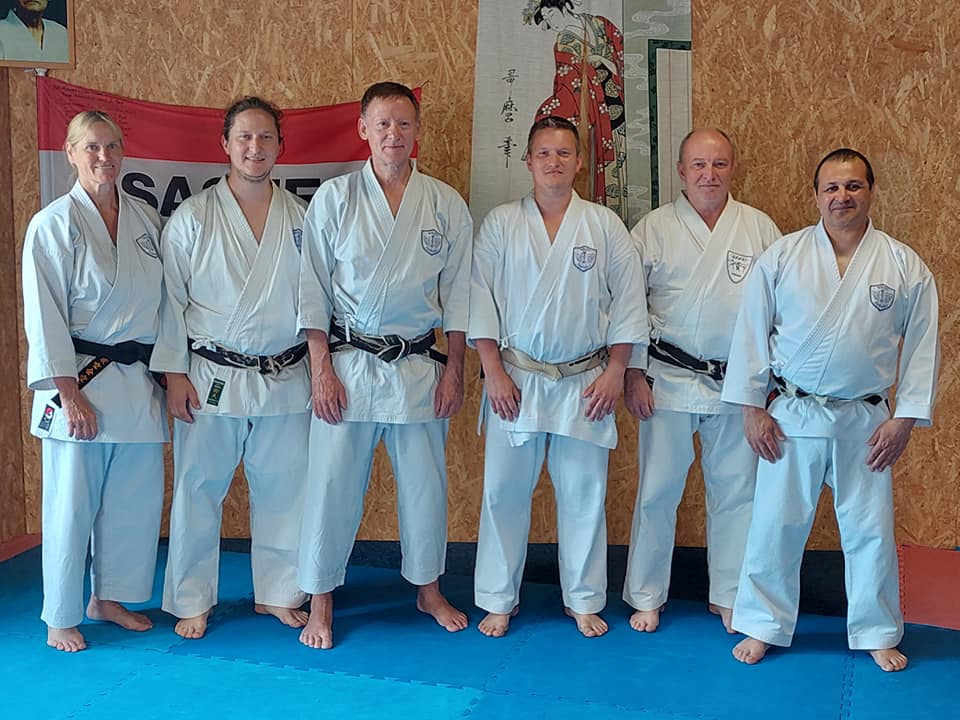
Report – March, Holland course with Tim Shaw Sensei.

I have been travelling across to seminars in the Netherlands for so many years now, initially to accompany Sugasawa Sensei, but eventually on my own, all down to the enterprising initiatives of the growing nucleus of Shikukai members in Holland.

The course organisation has been under the consistent captaincy of Martijn Schelen, who has always taken his personal inspiration from the teachings of Sugasawa Sensei as Shikukai chief instructor.

But this particular course had a special significance attached to it, as it is the first Shikukai course outside of the UK since the beginning of the pandemic (my last course in Holland was two years ago when we were on the brink of closing everything down and my Sunday night return to Stansted airport was marked by the image of an airport turned into a ghost town).

This time, despite the threat of Byzantine bureaucracy necessary to cross international borders, I was relieved and excited to be back on the seminar circuit. Fortunately, everything went smoothly.

The Dutch students I met told me how they had really been feeling the lack of seminars and events over the last few years, and here we were, back in the Dojo once again.

The training had been organised to spread over three days and was based in Martijn Shelen’s beautifully designed Dojo. I had always appreciated how Martijn had incorporated clever and subtle design features into the available space and had managed to strike the right balance between personalising the interior with idiosyncratic details, while creating the formality of a modern, uncluttered Japanese Dojo all without the need to add any unnecessary ‘Japanesque’ frills (something all too often seen in modern western attempts at Japanese interiors).

I was pleasantly surprised by the attendance; a good mixture of Martijn’s regular Dojo members and people who had travelled from much further afield, and in one case a senior instructor from Shotokan; but also, a healthy showing from kyu grades who were eager for the experience and to explore what the seniors were tapping into. I felt the need to be particularly watchful and to give them as much guidance as I could, because it is the kyu grades who are the long-term future of Wado karate.

Over the three days training I had programmed in a couple of underpinning themes; one was to understand how the whole body contributes to the execution of techniques and to get to actually feel how that mechanism works. The other was to develop/encourage a mindset that focussed on why we do things in certain ways; what do we gain from it? This was delivered through exploration of specific individual techniques and their methods of delivery, as well as kata and carefully selected Wado pairs work.

(I have published a separate blog post on the Shouwa Jyuku website as a series of supporting notes for the students who attended the course. Link).

We totalled eight hours of training over the weekend, but after training the conversations continued (as they always do).

Superb organisation by Martijn and Astrid, my thanks to both of them and to all the Dutch (and Belgian) trainees, a great opportunity to renew friendships and work shoulder to shoulder.

Watch this space for another Holland course later in the year.

Tim Shaw

Shikukai 2022 Winter Course – Report by Tim Shaw.

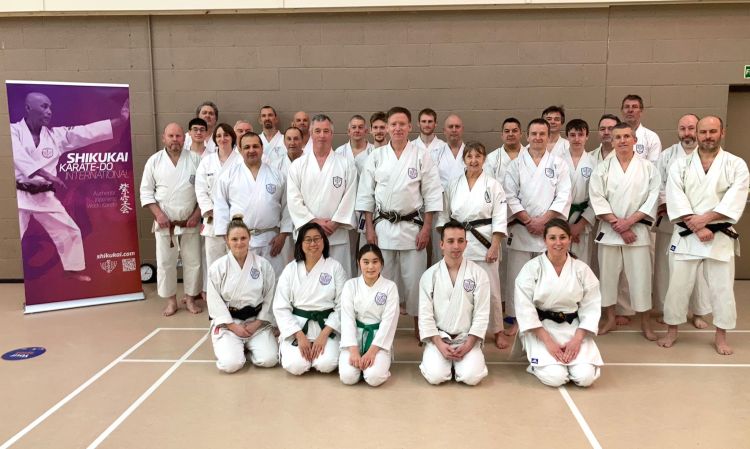
It was always going to be a risk to organise the first large scale face-to-face Shikukai course in two years, but we went ahead anyway, and I am pleased to say that it turned out to be a major success.

The course was over two days at the Danbury Leisure Centre, five miles from central Chelmsford in Essex, and attracted Shikukai members and non-members from all over the UK.

Here in Essex, we have been hosting the winter course, even before it was recognised as the ‘official’ Winter Course for a long time now. Actually, this has been over ten years of continued teamwork by the Shouwa Jyuku seniors, who have been dedicated to the task of making sure everything runs like clockwork and that time and space for some serious training has been facilitated. Top that off with a stella group of senior Shikukai instructors and you have the perfect combination for an amazing weekend. This was brought home by the broad smiles on people’s faces – I think we were just pleased to be back in the Dojo and working together collectively.

Training had been designed to tap into the very things we’d missed the most; for example, on both Saturday and Sunday, an hour and a half each day was dedicated to Kumite (pairs work). We also pulled everything back to core principles – Sugasawa Sensei had been very insistent that we return to our fundamentals and review the areas that are best designed to highlight those elements; hence, for the seniors, the kata section focussed on Pinan Shodan and Pinan Yondan. These two particular kata will easily reveal your weaknesses and force you to examine your essential Wado mechanisms.

The training covered a wide range of techniques and was comprehensive at all levels; nobody felt out of their depth; yes, we were challenged, but this was very much about improvement and growth. Across the two days the training maintained the balance of being physically demanding and technically challenging; so much information coming from the instructors and shared between the trainees.

In addition, although we had scaled it down from previous years, the social opportunities and chances to get together on the Friday and Saturday evenings happened anyway. Our organisation team had booked tables at local restaurants, which inevitably spilled into enjoying the local music scene in Chelmsford on the Saturday night. Naturally, everyone was aware of the demands of Sunday’s training, with some people taking grading exams, so things remained civilised.

A Shodan examination happened on the Sunday and the successful candidates were:

Margaret Harris of Kikuwa Jyuku Dojo, Chippenham.
Tom Wilkins of Mushin Jyuku Dojo, Devon.

I am very much indebted to the invaluable contributions of instructors; Pam Rawson 7th Dan, Steve Rawson 7th Dan, Richard Barham 6th Dan, Rob Selby 5th Dan and Steve Thain 4th Dan. And for the continued inspiration of Sugasawa Sensei.

Special thanks to Steve Thain and Natalie Harvey for their tireless organisation and coordination, without which this would never have happened.

The next main Shikukai course is the Spring Course in Weymouth, details on our ‘Courses’ page.

Report – January Kumite-based training in Weymouth.

Ken Bu Jyuku hosted a Kumite based training at The Combat Lab on Saturday 22nd January 2022.

This is a newly opened Martial Arts venue in Weymouth and a small group was invited from Kiku Wa Jyuku Chippenham and Mushin Jyuku Exmouth to join Weymouth students for a trial session.

Students were able to take full advantage of the excellent facilities including matted area, bags and pads. Following a successful afternoon it is planned to hold further such courses in the future.

Steve Rawson 7th Dan.

2022 New Year Instructor’s Course – Report.

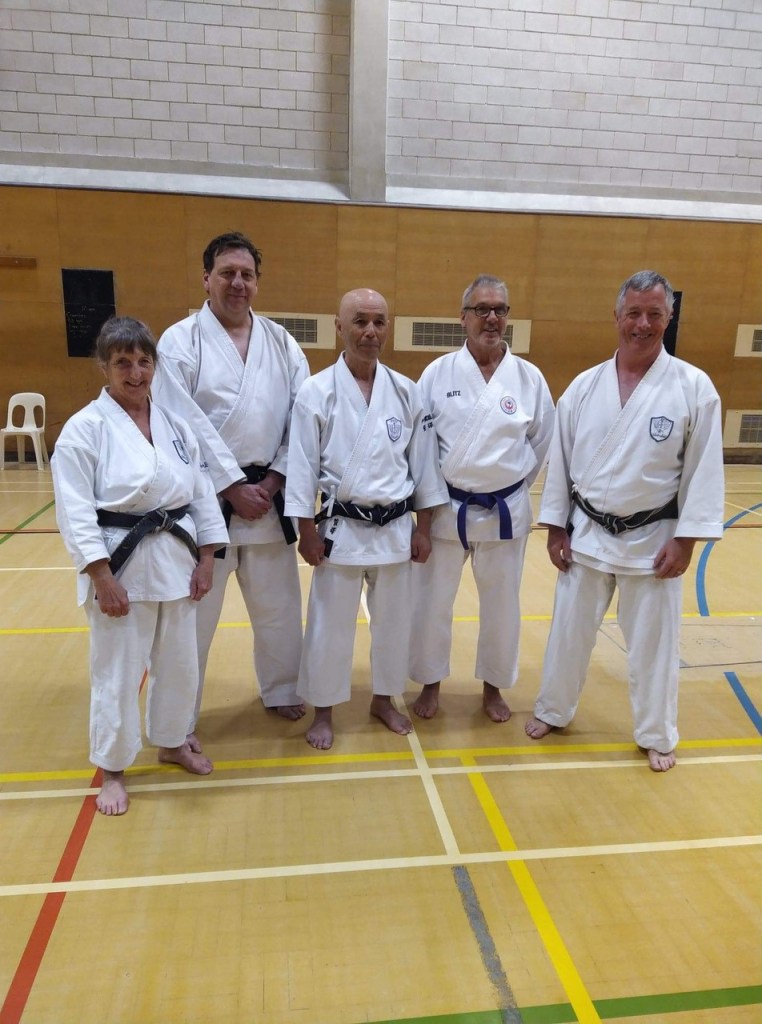
On Saturday 8th January 2022, Sugasawa Sensei led the traditional New Year training with the Shikukai club instructors in the dojo, marking the first opportunity for face-to-face training since the usual schedule was rudely interrupted by the Covid pandemic. For me personally it was a privilege to host the session and a sheer joy to be training with Sensei and the instructors again. The session was also the first hybrid instructors training session with a further 24+ people joining via video link from their own dojos or homes.  

The session began with some words from Sensei explaining that we cannot be ruled by coronavirus and that we need to find a way around the predicament. He also explained that this session was an opportunity for some intensive training to kick-start the New Year.

After some gentle warmup stretches from Pam Rawson Sensei, we moved on to sonoba-waza with a variety of hand forms, and then Unsoku, or Ashi-sabaki practice (stepping or moving forward with different foot movements.) Despite the way the practice is named, it became clear that this is about generating momentum and range of movement from a stand-still position while keeping your Sei-chu-sen intact and protected, regardless of which stepping pattern is being practised. The level of success being achieved soon became apparent when striking techniques were added. The first hour was rounded off nicely with an increasingly vigorous kicking drill from Pam Sensei, built on Tsugi-ashi and requiring different preparation of the hips for each kick.

Tim Shaw Sensei then led the practice with a look at how certain aspects of Kihon Kata evolve into Pinan Nidan. In particular he explained how dropping energy is introduced in the first movement of Pinan Nidan (something that would come up again later), and the way each half of the body is utilised in equal measure in executing Jun-no-koshi. The points Tim Sensei drew out, illustrated how even a simple kata contains endless fine details that can improve our practice.

We then moved on to some pair work drills (with actual partners to practice with!) practising Nagasu movements, utilising Jun-no-koshi and Gyaku-no-koshi, against the same Gyakuzuki chudan attack.

Steve Rawson Sensei then led the final section of the day’s training, returning to kata with a detailed breakdown of Seishan movements. He explained how creating tension in the Tanden stabilises the body, whereas excessive tension in the arms leads to unwanted shaking. The switching between tensed and relaxed states is an obvious feature of the first (slow) section of the kata, but Sensei explained that a similar principle is used in the Age-waza section, where the body goes into full stretch to make a high-rising technique and then relaxes and contracts to add energy to the following dropping action, enabling the body rather than the arm to add energy to Ura-uchi. The same principle was in fact practised earlier in the opening movement of Pinan Nidan!

Steve Sensei’s session closed with some Ura-no-kumite and Kumite-kata drills, where he observed that the former are simply building blocks that can be combined into more elaborate forms as found in Kumite-kata and Kihon Gumite. It was interesting to make some connections between Seishan and these pairwork drills, the most obvious being the concentration of energy in the Tanden to stabilise the defensive postures. Seishan dachi also featured in the practised Kumite-kata, as did the stretching-contracting principle (again) and even the arm shape practised in the opening section of Seishan is found to be the strong option for the first movement of the Kumite-kata.

By now we had gone over time. I don’t think anyone minded and we could easily have continued for another hour. It was so refreshing to be training together again. Now looking forward to the Winter Course… 

Richard Barham 6th Dan.

Success for Jess Lee.

Jessica Lee has trained with Chippenham Karate Club since she was 6 years old. She has trained regularly, taken part in competitions and helped out with the children’s classes each week. 

The plan was for Jess to take her Dan Grade in 2020 but unfortunately this was not possible due to the pandemic.

Jess is now 18 and emigrated to Australia earlier this week.  Before she left, Sugasawa Sensei very kindly authorised her to attempt a Dan Grading. This took place at the Olympiad Leisure Centre in Chippenham on Monday 6 December.  The grading panel consisted of Senseis Steve Rawson 7th Dan, Pam Rawson 7th Dan and Carol Chatterton 6th Dan, with Sugasawa Sensei overseeing the grading via Zoom.  

I am pleased to say Jess passed and it was lovely to see her obtain her black belt before heading off to pastures new.

We will miss Jess at the club and wish her well for the future.  Her plan is to continue to train and hopefully start a club of her own one day!

Best of luck Jess, keep in touch!!

Carol Chatterton 6th Dan

Please join us for the Winter Course 2022

Shikukai Winter Course 2022 will be the first major face to face course that Shikukai has held post restrictions. Our vision is to create a focused, smaller, boutique course that connects us to our Wado. It will be different to the usual large courses we’ve held in the past, but with Sensei’s guidance it’s sure to be a success. 

It is important that we manage the numbers carefully this year.  Please contact us to let us know you are coming (or thinking about it) etc.  Give us your Mobile number and we will add you to a WhatsApp Group just for this event.  

Saturday 12th Feb 11:00 Registration / warm up   

11:30am – 3:00pm (3:00pm-3:30pm) personal practice

Sugasawa Sensei & Shikukai Senior Instructors

Danbury Sports Centre, Danbury CM3 4NQ

Sunday 13th February 11:00 Registration / warm up

11:30am – 3:00pm

Sugasawa Sensei & Shikukai Senior Instructors

Danbury Sports Centre, Danbury CM3 4NQ
Sunday 13th will also include:

  • Kyu Gradings   3:00pm – One month notice required please
  • Dan Grading     4:00pm – Formal handwritten letter to Sensei by 11th January 2022

Free parking –  Danbury Sports Centre has an upper and lower car park—————————————————————————————–

Course, Grading and registration fees 2022

  • Kyu Grading Fee £14.00 – One month notice required please
  • Dan Grading Fee £25.00 – Formal handwritten letter to Sensei by 11th January 2022

Attendance to the course must be booked for and paid in advance

Paypal https://www.paypal.me/StevenThain

2 Day Rate

  • Adult member – £50
  • Adult Non-member – £60
  • Junior (11-17yrs) member – £30
  • Junior (11-17yrs) Non- member – £40

1 Day Rate

  • Adult member £30
  • Adult Non-member £35
  • Junior (11-17yrs) member £15
  • Junior (11-17yrs) Non- member £20

——————————————————————————————-

Additional Dojo time
 

  1. Thursday 10th February. Shouwa Jyuku regular dojo session
    7:30pm -9:00pm
    Woodham Walter Primary school, The Street, Woodham Walter CM9 6RF
    Open to all.  £10
     
  2. TBC – Friday 11th February. Shouwa Jyuku Instructor led
    6:00pm – 8:00pm
    This session is TBC and very much subject to demand.


Covid.  We will be exercising an upper limit of attendance. We ask that if you aren’t double vaccinated that you carry out a covid test before arrival to the course and do not attend if you have any symptoms. https://www.nhs.uk/conditions/coronavirus-covid-19/symptoms/
Cancellation due to Covid.  If you test positive, we will refund any payments you’ve made to the course.

Social.  We won’t be organising the usual large group meal this year. We suggest people organise themselves for meals in the evenings. We will arrange a meet at a couple of central pubs at the time.

Accommodation. There are many options for accommodation in Chelmsford. Sensei will be staying at the Premier Inn Chelmsford City Hotel. CM1 1NY

Money.  We intend to be cash free this year. You will need to pre-book your place onto the course with payment made in full one month prior to the course, this will help us in planning to give the most benefit to your training.  Paypal https://www.paypal.me/StevenThain

WhatsApp. Please email your attendance and payment along with your mobile phone number, we will add you to a group for the event that will give important information out.

International students.  International students please email us for your attendance. Stansted Airport is the closest airport to us. There are regular affordable  buses that run to Chelmsford regularly. If you are having difficulty with this, please contact Steve, Tim or Natalie.

Steve. thethains41@gmail.com /  07989 257044 

Tim. timshaw499@hotmail.com /  07585 707718

Natalie. natalie.harvey9@gmail.com /  07972 790246

Facebook@chelmsfordshikukai 
www.wadoryu.org.uk
www.shikukai.com

Report: Shikukai Autumn Zoom Course 30/31 October 2021.

This year’s Shikukai Autumn Course was held over two days via Zoom. Whilst this type of training has its limitations, on the positive side it meant that everyone could get together without geographical constraints.

Saturday’s session welcomed students from many parts of the UK, Norway, Holland, France and Australia. Sensei opened the proceedings, welcoming everyone and was pleased to see how many people had made the effort to attend.  He then handed over to his team of instructors, whilst keeping a close eye on events.

The first session for all grades was taken by Richard Barham 6th Dan Sensei. The first part was a warm up including breathing exercises initiated from the Hara, not merely the chest. He then concentrated on core basics and how they related to Kihon and Kata.

For the first time, Zoom Breakout rooms were used, enabling sessions to be more grade specific. The instructors had previously met together via Zoom to work out the technicalities and all worked well on the day.

Tim Shaw 7th Dan Sensei took the Dan Grades for an hour long session, which he split into two parts. The first half was focussed on the relationship between the centre and techniques that operate at the furthest edges of our reach; including examples from Kihon and Kata. The second half concentrated on operating multiple sequential techniques with the same hand, all connected to the body movements, which, in turn, created free-flowing fighting combinations.

Concurrently, the other Breakout Room for Kyu Grades was lead by Steve & Pam Rawson 7th Dans Senseis. They concentrated on the 60 moves of Kushanku Kata as demonstrated by Grandmaster Otsuka II many years ago on one of his UK courses. The similarity between the first and last moves of the Kata was demonstrated. Use of the Hara in these moves linked back to Richard’s initial session. Some simple Kumite drills were then practised, incorporating moves from the Kata.

The Breakout rooms were then closed and everyone resumed training together for the final 30 minute session which was lead by Bob Wymer 5th Dan Sensei. He linked the movements of the first five Kihon Gumite into a sequence, making it easier for the junior grades to start learning the basic attacks and defences.

Sunday saw a similar number of 40+ students attending with the first general session being taken by Rob Selby 5th Dan Sensei. Rob’s focus was on moving off line and engaging Hara utilising Koshi wo Kiru. He did this by way of a series of drills which stretched both mind and body. The second part looked at various Renketsu Dosa from the Shikukai Syllabus showing how the movements practised in the drills were evident.

The two Breakout sessions were then opened. Steve & Pam Rawson took the Dan Grades, focussing on a series of kumite drills which could be used in a general sparring scenario. These were then varied to incorporate the hand techniques pictured in the Shikukai syllabus. The effect of this was to change the emphasis from competition style to a more traditional Jiyu Kumite.

Steve Chamberlain 7th Dan Sensei took the Kyu Grades. His focus was on explaining to the students what an examiner would look for in a Kyu Grading examination including distance, timing and Zanshin.

Once the breakout sessions were concluded and everyone returned to the main room, Pam Rawson explained how the meaning of familiar Japanese karate terms can be understood from how they are written in Kanji. Among the examples she gave was how the Kanji for Sen ()  “before/to lead/proceed” appears in the following:-

Sen Sei

Sen Sen No Sen 先 先

Senshu

To keep up momentum Steve Rawson ended the course with a set of kicking drills culminating in a short warm down. Sensei closed the course by thanking everyone for their efforts and is looking forward to when we can all train together face to face.

Pam Rawson 7th Dan

7th November 2021