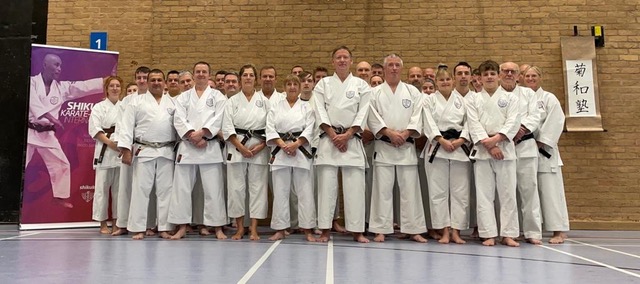
It is always a pleasure to welcome the Shikukai family and friends to Weymouth & Portland for the annual Spring Course and this year was no exception.
Planning for the event always starts the previous year, with the booking of the venue. This year, proceedings started early, with Sugasawa Sensei, Julie and Steve Chamberlain calling in to the Rawson residence for a spot of lunch and a pre-course chat. Following on from Ken Bu Jyuku’s normal training session later that evening, the Norwegian contingent arrived. Friday saw the arrival of students from across the country in preparation for the first training session that evening.
The theme of the course was ”Bu no Honshitsu wo Mikiwame” (Absorb the essence of Budo)
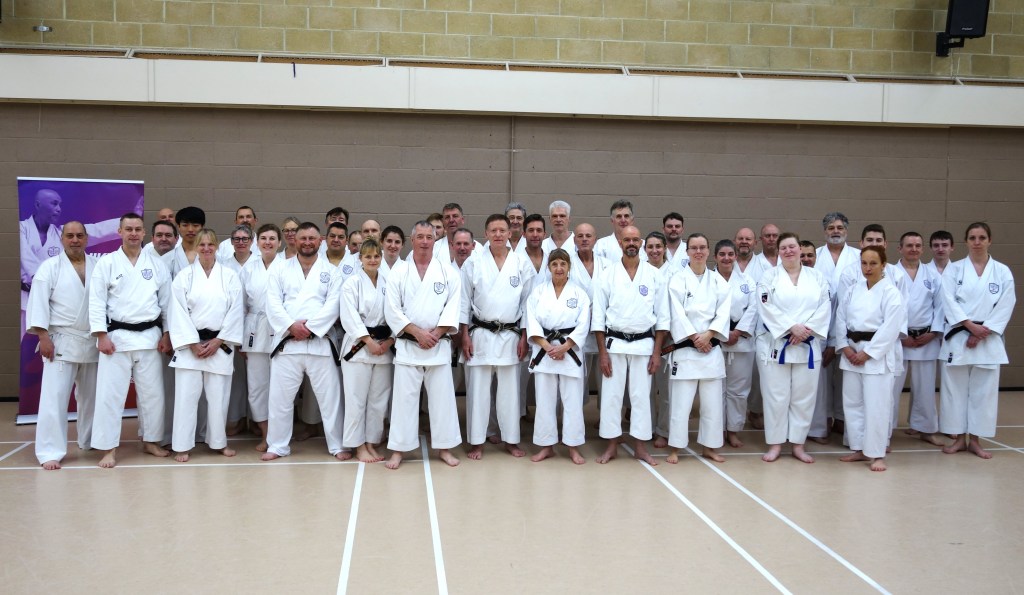
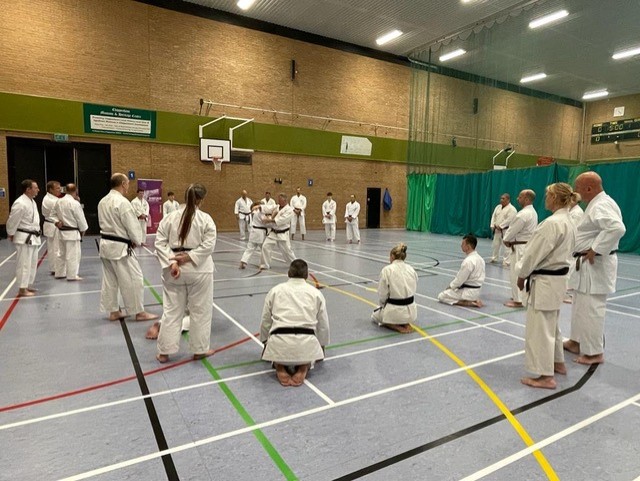
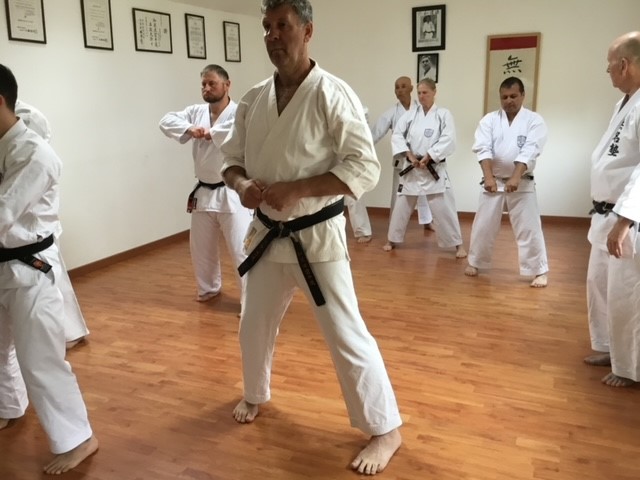
Friday’s session commenced with an opening speech by Sugasawa Sensei who welcomed and thanked everyone for attending, including Andrew Genery from Kishin Kai Karate and his student, plus the international students. Sensei’s message was that Karate should not be viewed merely as exercise, but a means to acquire knowledge and that “we were all in it together, no matter how hard it may seem.” An hour of basics followed, where the tiniest of detail was scrutinised, culminating in the students working in pairs to practice timing and distance. Sugasawa Sensei gave special attention to the potential Dan Grade candidates, which he continued to do throughout the course.
Prior to training on Saturday morning, Meg Chatterton ran a complimentary Yoga Class for students at a nearby venue. Donations were made to Pancreatic Cancer.
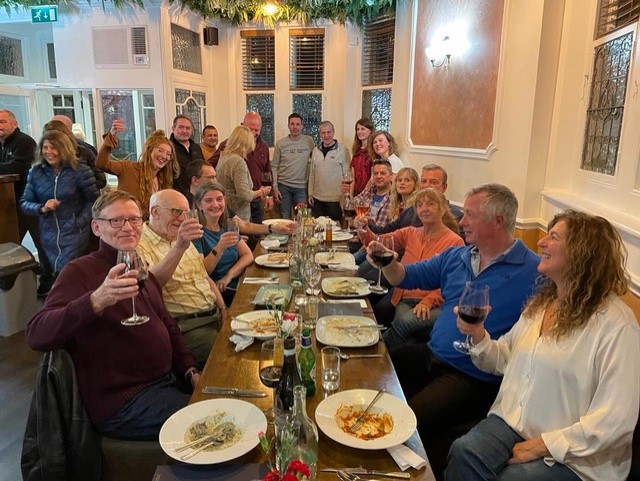
Saturday saw the four senior Shikukai Instructors, Tim Shaw 7th Dan, Steve Chamberlain 7th Dan, Steve Rawson 7th Dan and Pam Rawson 7th Dan take various groups under the watchful eye of Sugasawa Sensei for Kihon, Kata and Pairworks. On Saturday evening the senior Shikukai Club Instructors enjoyed a social meal and gathering at Weymouth’s prestigious sea-view Italian restaurant.
Sunday took on a similar format to Saturday with the senior Shikukai instructors leading various groups with Sugasawa Sensei overseeing the instruction and ensuring no details were overlooked. The 3rd – 1st Kyu group were particularly fortunate in receiving sustained and detailed instruction on Nai Hanchi kata from Sugasawa Sensei.
Monday began with a meeting for the Shikukai Club instructors where it was decided to hold the 2025 course in Weymouth & Portland. Training again was split into groups, with Sugasawa Sensei once more concentrating on the intricacies of Nai Hanchi kata. The senior Dan Grades were tested both physically and mentally with a Tai Sabaki drill comprising of many elements.
All too soon, the four days of training was over. Sensei closed the Course and thanked everyone for attending.
The formal Dan Grading then commenced with four students attaining 1st Dan:
I have been travelling across to the Netherlands now for around a decade; initially with Sugasawa Sensei but more recently to continue the support for Shikukai students who are now well-established within our organisation and continue to thrive through the hard work and dedication of Martijn Schelen de Vries.
Although it had only been a matter of a few weeks since we saw a strong Dutch contingent at the Shikukai Winter Course in the UK, there seems to be no lack of appetite for guidance and instruction. I am always happy to oblige, as the welcome in the Netherlands is second to none and the enthusiasm of the students at all levels is truly infectious.
Friday evening kicked off the training as we meant to go on. As usual I established my themes, but all in negotiation with Martiijn. I am always keen to respond to requests as it is really important that Shikukai students are kept up to date with developments and refinements of the syllabus – we tend to jokingly refer to this as ‘Operating systems updates’, (all directed by Sugasawa Sensei, of course). We find that these are essential, as the Shikukai syllabus and the continued fine-tuning, is an ongoing process.
The Kihon aspect of Friday training was an essential underpinning of everything that was to follow across the weekend.
Kyu grades were set the task of applying timing and distancing in operating two models of the dropping cover/block found in the syllabus; while the seniors worked Kihon Gumite and Kumite Gata.
On Saturday, we had a longer dedicated period unpacking the first part of the solo kata Pinan Godan. For some reason, in all the years I had been coming over I realised we had never been through this particular kata. To introduce the kata, I included broken-down aspects of individual techniques found within the form, and later on kaisetsu (commentary) regarding the implied usage of the covering/protective hands.
This was followed by the junior grades training in Nihon Gumite, while the seniors again explored the various Kihon Gumite and Kumite Gata.
Sunday: another three-hour session. This one was reserved for the kicking techniques, as found in the Shikukai syllabus; inclusive of variations on the back kick (ushiro geri). We also completed the remaining section of Pinan Godan.
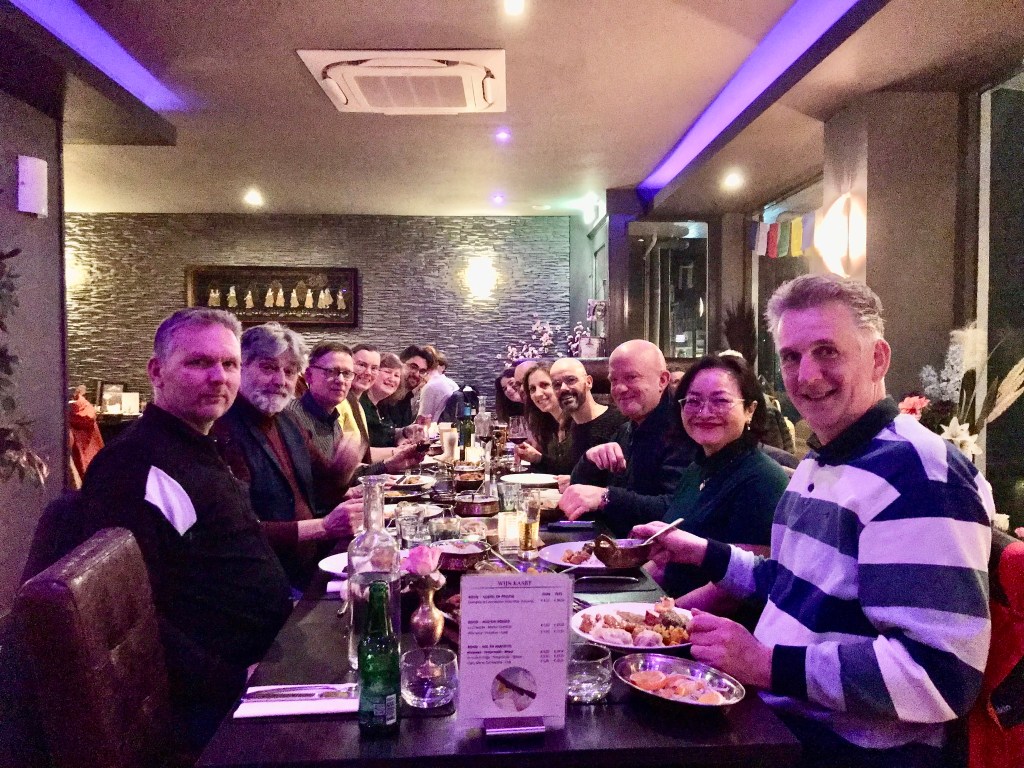
Saturday evening; we had time to relax and unwind over an excellent meal, again at the Gorkha Restaurant in Hilversum. We had the opportunity to taste Nepalese wine (a first for me), I had never thought of Nepal as a wine growing part of the world, but apparently the vineyards are some of the highest elevated locations on the planet (2,750m/9,000ft); I’m not enough of an expert to know how that affected the wine.
We somehow managed to cram so much training in across the weekend, which, from my perspective seemed to be over before it began.
We already have plans for the next course in the Netherlands this year. A date in November is already earmarked, more details to follow.
For the next course, Shikukai in the Netherlands (Kenkokai) are keen to invite other Wado practitioners from the UK and Europe, but places will be limited, so get in early once the dates are announced.
For this course, I have produced a series of support notes which will be published on my Substack project, www.budojourneyman.substack.com
A huge thanks to my hosts Martijn and Astrid Schelen de Vries.
Shikukai Karate-Do International runs three major courses every year; Winter, Spring and Autumn (see calendar page for details). These courses are open to all Wado karateka whatever their affiliation.
This year, as usual, it was our privilege to host our Winter Course in February in Essex.
Long in the planning, the two-day official training was strongly supported by students from across the UK and the continent. The content of the course covered the fuller spectrum of the Wado karate techniques, as represented on the Shikukai syllabus. All of this was delivered by a strong team of senior instructors, who had carefully designed the delivery of technical knowledge and information, which I know was greatly appreciated by students at all levels.
As usual, there was an ‘unofficial’ start to the course; this was the additional Dojo time organised for those wishing to maximise the training opportunity, particularly those coming from far-flung locations. This took place on the Thursday and Friday at Woodham Walter. These sessions were designed as a kind of primer to the main training, specifically offering extra tuition to those who were planning on grading at the end of the weekend. This meant that the students had accumulated an extra three and a half hours of Dojo time before the course had officially started.
Across the weekend we were privileged to tap into the considerable knowledge of senior instructors Steve and Pam Rawson from Dorset, Richard Barham from Surrey, Rob Selby from Devon and Steve Thain, local instructor, from Essex.
In addition, on the Sunday, Sue Dodd and Richard Barham conducted the training for the younger junior members of Shikukai, with students from Woodham Walter and Hertford.
The themes across the training were rich and varied, but following strict guidance from Sugasawa Sensei, who was insistent that instructors and students paid rigorous attention to the absolute fundamentals of Wado karate.
In addition to essential kihon, we covered the solo kata of Naihanchi, Kushanku, Chinto, Rohai, Jion, as well as an appropriate selection from the Pinan kata.
Add to this the paired kata of kumite gata and kihon gumite, which were covered in some depth across the four days.
The truly international nature of the course was attested to by the presence of students from the Netherlands, Hungary, Czechia (and Japan) all part of the wider Shikukai family.
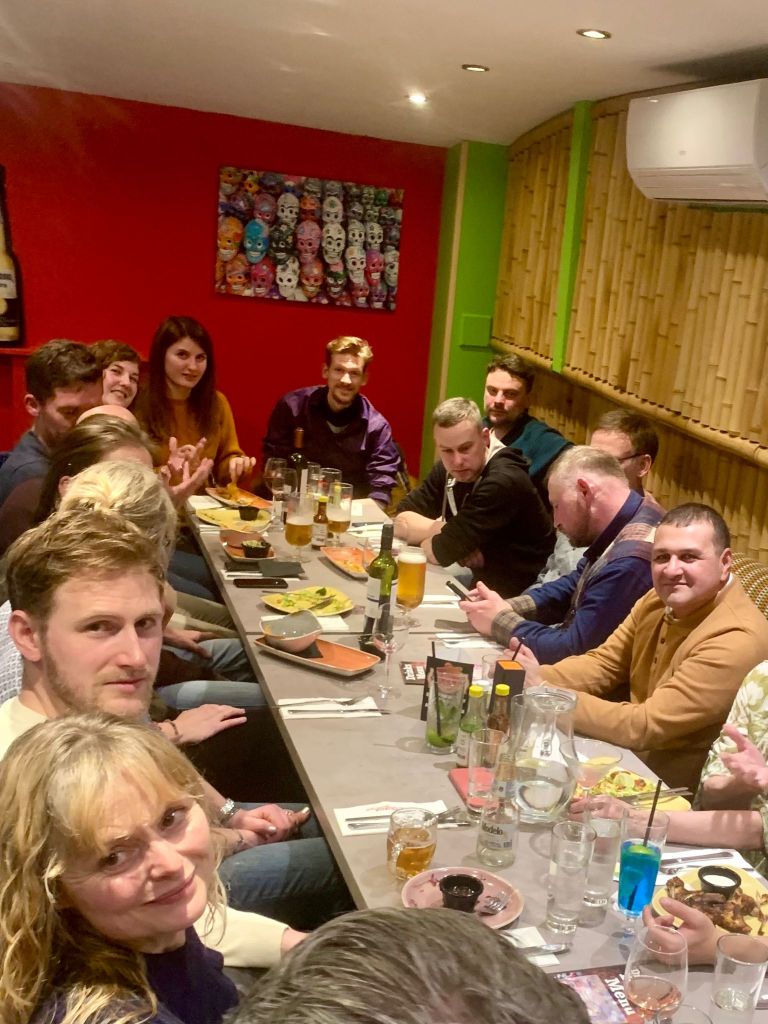
It wasn’t all about the training; there were opportunities to socialise. On the Friday after class a large group of us descended on the Salero Lounge in Maldon for after-training refreshments. While on Saturday we all went ‘Mexican’, for some excellent food at El Guaca restaurant, again in Maldon.
Grading results, congratulations to:
1st Dan, Bence Kepes, Genki Dojo, (Hungary).
6th Kyu, Will Doble, of Mushin Jyuku (Devon).
1st Kyu, Andrew Skelton, of Kikuwa Jyuku (Chippenham).
8th Kyu, Polina Pylypets, of Shouwa Jyuku Kodomo (Essex)
6th Kyu, Jamie Richardson, of Bunbu Jyuku (Hertford)
Thanks to:
The amazing instructor team who went beyond the call of duty to deliver the outstanding quality of direction and guidance across the whole weekend.
The support team who seamlessly stitched the weekend together without a single hitch. These were the on-the-ground people who organised lifts, restaurants, advising on accommodation and all of the multiple communication and admin tasks.
Also, (really important) a huge thanks for the continuing support of all the participants. Without you these courses cannot happen. Your continued endorsement of all Shikukai events enables us to go forward and develop this wonderful unique tradition inspired by those who have gone before us and the continual inspiration of our chief instructor, F. Sugasawa Sensei.
The Training and Grading on 27th January was planned mainly to assist future Dan Grades to go through their various syllabi under “mock” exam conditions, although all grades were welcome to attend. The course was well attended with students from Ken Bu Jyuku, Kiku Wa Jyuku, Mushin Jyuku and Chertsey.
After a short warm up the lesson was underway. As space was at a premium in the upstairs Dojo, quality rather than quantity of techniques was the order of the day. All students were taken through basics for the Dan Syllabus with the junior grades enjoying the opportunity to try something different.
As there were quite a few different katas to cover for 1st/2nd and 3rd Dan, the students were taken through various moves which were common to several of the katas, before having the chance to practice their particular katas in small groups. Whilst the seniors were working on their pairwork, two students from Ken Bu Jyuku took a formal 5th Kyu Grading.
After two and a half hours eveyone took a short break before attempting the Mock Dan Grading.
It was interesting to learn from the students how the nerves unexpectedly crept in, even at this early stage.
At the end of the session everyone migrated to the nearby Beehive Cafe on Portland for some well earned refreshments and structured feedback on performances.
Steve & Pam would like to thank everyone for attending and for the effort they put in.
Winter Karate Wado course – Shikukai Prague 8-10 December 2023
By David Vlk 3rd Dan
Teacher Richard Barham 6th Dan
Sue Dodd 2nd Dan.
After some years, the opportunity to organize a Shikukai course in Prague arose again. Since Prague is a beautiful and magical city, we thought about who to invite. We were looking for someone who already has extensive experience with Prague and who knows us as the Shikukai Prague club. Sugasawa Sensei was the perfect choice, but it didn’t work out, so a plan was hatched during the Bretton course to invite Richard Barham 6th Dan. Richard and I know each other very well and we were pleased that Sue Dodd 2nd Dan, also planned to come along, so excellent exercises and a great accompanying program were offered.
The course was divided into two parts, a special session on the Friday for Shikukai students, and then the main course on Saturday and Sunday, open to all those interested in the Wado practiced in Shikukai. Friday was very intense with an excellent Christmas Advent atmosphere. Both kihon kumite and kumite kata were discussed – so it was a lot about pairing and controlling the distance. It was a small group so everyone got their due attention.
Saturday was the first open session, where children under 13 were also present, who practiced for only 1.5 hours. Many of the older students took part, which meant that we were free to carry on from Friday’s practice into Saturday. The material discussed was devoted to the three rules of SAN MI ITTAI DOSA and their use in practice, i.e. both in kumite and in kihon or kata. While this provided an underlying principle for the practice, many other aspects were built on to this foundation. Richard and Sue put a lot of energy and work from these rules, which they gave us, and for some it was an unimaginable movement, full of simplicity on the outside, but hard work on the inside.
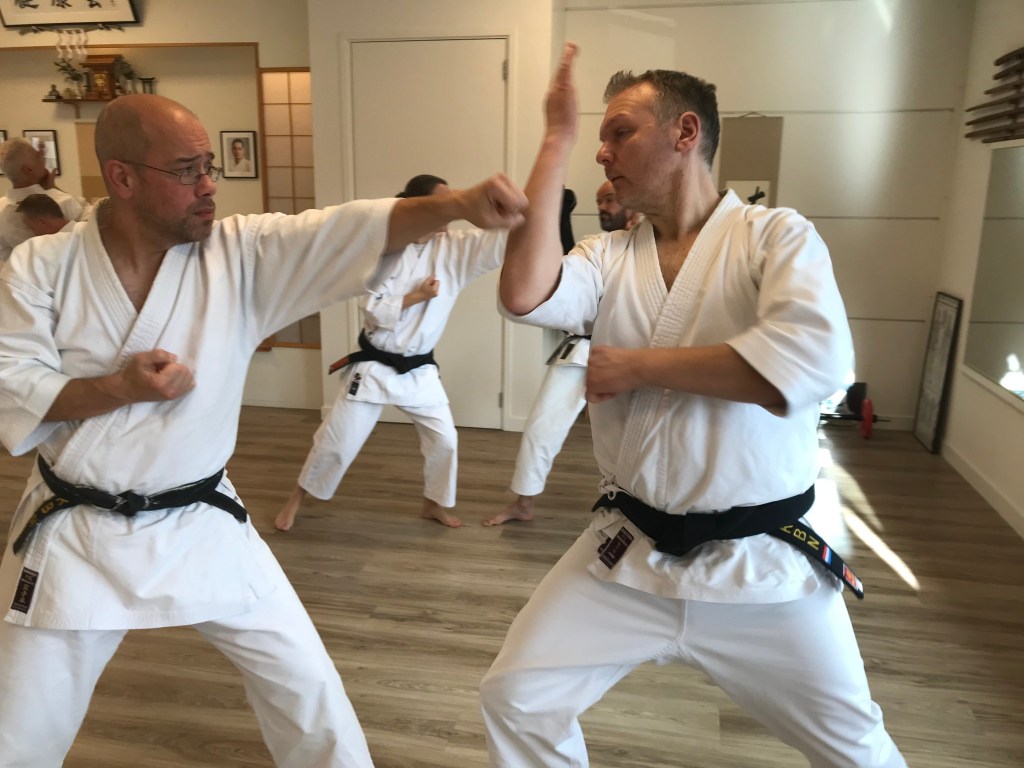
Sunday started with morning training. Without abandoning any of the lessons from the previous day, we continued by working hard in pairs beginning with nihon kumite and extending the techniques to Kihon Gumite and Kumite Gata for black and brown belts. The kata for both days were Naihanchi and Kushanku, while the junior worked on Pinan Shodan. Richard explained that the same principles should be uppermost in mind, regardless of whether practicing Kihon, Kata or Kumite.
Throughout the course, it was interesting to observe the lightness and functionality of these techniques, but the practice was sometimes insurmountably difficult and complex, where not only the hands but also the brain got tangled. At the end of the course, it was interesting that Richard hit the mark and tested us all at the end.
We thank Richard and Sue for an excellent course, which was very professional on their part, and they won everyone over with their human approach.
I would also like to thank the participants who came to this course, namely the Genki club from Hungary, the jiu-jitsu club, the Kbely karate club and, of course, Shikukai Prague.
We also enjoyed Prague at night and Christmas Advent in the heart of Europe.
Footnote from Richard Barham.
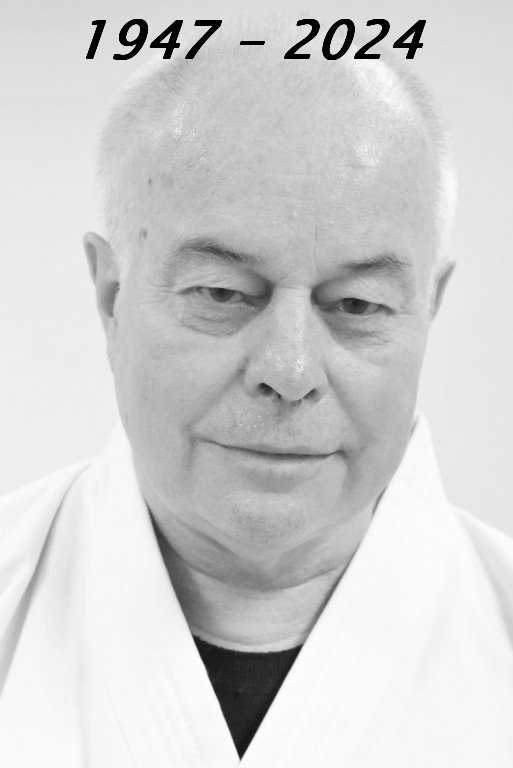
I was very sad to here of the recent passing of Josef Zvěřina, whom I had the honour and privilege to meet during this course. Josef began his training, first with Judo, and then karate since 1964, and so was amongst the very first in Europe to experience this fine art. He has since inspired his son and granddaughter to train, both of whom are now with Shikukai. As he observed from the side lines, Josef told me that he was very impressed to see how Wado had developed from those early days. He said that he could notice our way of relaxed movement and kime, and could immediately appreciate the benefits of practicing this way. My sincere condolences to Martin and his family.
Zimní kurz Karate Wado – Shikukai Praha
8.12.-10.12.2023
Vyučující Richard Barham 6.Dan
Sue Dodd 2.Dan
Po delší odmlce a po COVID pauze, se opět naskytla možnost upořádat kurz Wado Ryu v Praze. Jelikož Praha je krásné a magické město, tak jsme přemýšleli koho pozvat. Hledali jsme někoho kdo již má bohaté zkušenosti s Prahou a kdo nás zná, nás jako klub Shikukai Praha. Volba byla jasná, ale neprošlo to, tak plán „B“ – Richard Barham 6.DAN J Jelikož s Richardem se známe velmi dobře a sedíme si, tak dohoda byla rychlá, jednoznačná a termínově jsme se přizpůsobili jeho požadavkům. Pozvání přijala i Sue Dodd 2.DAN tak se nabízelo výborné cvičení a skvělý doprovodný program.
Kurz byl rozdělen na dvě části a to pro hnědé a černé pásy spolu s nimi i trenéry a druhá část (sobota a neděle) otevřená všem zájemcům o tento kurz. Pátek byl velmi intenzivní s výbornou atmosférou vánočního adventu. Probíralo se jak kihon kumite, tak i kumite kata – taže to bylo hodně o párech a kontrolování vzdálenosti. Byla to malá skupina a tak se každému dostalo patřičné pozornosti.
Sobota už patřila volné hodině, kde byli přítomný i děti do 13let, kteří cvičili pouze 1.5hodiny. Účastnilo se mnoho starších studentu, což znamenalo, že jsme volně pokračovali z pátečního tréninku i v sobotu. Probíraná látka se věnovala třem pravidlům SAN MI ITTAI DOSA a jejich použití v praxi, tedy jak v kumite, tak v kihonu či kata. Nebylo by správné říci, že jsme se věnovali té a té dané kata, protože Richard se Sue dali hodně energie a práce od těchto pravidel, které nám dávali zabrat a pro některé to byl nepředstavitelný pohyb, plný jednoduchosti na venek, ale těžké práci vnitřně.
Neděle se začalo dopoledním tréninkem stejně jako v sobotu, ale již bylo u trochu méně lidí , ale nic to nezměnilo to že jsme nepracovali na technice z předešlých dní. Následovala tvrdá práce ve dvojicích a tvrdý trénink jak v nihon kumite tak i v kumite pro černé a hnědé pásy. Kata po oba dny byla Naihanchi and Kushanku a základní kata Pinan Shodan.
Po celý kurz bylo zajímavé sledovat lehkost a funkčnost těchto technik avšak praxe byla leckdy nepřekonatelně těžká a složitá, kde se nezamotali jen ruce, ale i mozek. Na konci kurzu bylo zajímavé, že se nám Richard trefil do noty a všechny si nás na závěr přezkoušel J
Děkujeme Richardovi a Sue za výborný kurz, který byl z jejich strany velmi profesionální a lidským přístupem si získali snad každého J
Děkuji i účastníkům kteří přijeli na tento kurz a to klubu Genki z Maďarska, klubu z jiu jitsu, karate Kbely a samozřejmě i Shikukai Praha.
Užili jsme si i noční Prahy a vánočního adventu v srdci Evropy David Vlk
It’s always been a bit of a tradition to open up the scheduled Xmas instructor training to all Shikukai members irrespective of grade; this year was no exception.
The venue was Egham Orbit Leisure Centre in Surrey, an excellent location being a very newly-built sports complex and easy to get to.
Although Sensei directed the training, he farmed out some responsibilities to other senior Dan grades. Rob Selby 5th Dan from Devon took us through a good warm up and stretch and Steve Thain 4th Dan from Essex, led training in footwork and movement as specified by Sensei. Here, Sensei was warming into his theme, as he folded in the appreciation of other aspects that were to feature later in the session.
The main subject areas.
Quite a few people had heard of ‘Kobo no Ichi’ as a concept; at one level it looks like a simple exhortation to just be aware that attack and defence are supposed to be one and the same, but as Sensei unpacked it, it became clear that there is more to it than that. To most of us, the main question was, how does this actually manifest itself? Sensei was able to show by examples in kihon and kata what it looks like when Kobo no Ichi is absent. This is always a very useful teaching device, in that showing what something is not helps to explain what it actually is.
‘Kime’ was also a theme that was included in the session. Sensei shared with us his reminiscences and memories of observing the first grandmaster’s actualisation of ‘Kime’ through technique; which was helpful in explaining to us how it works within Wado (as very different to how other styles choose to interpret Kime).
Pinan Shodan acted as a convenient medium to shed light on some of these concepts, as well other technical refinements.
Directly after training the senior instructors joined Sensei for a short meeting, during which Sensei was pleased to point out the steady growth of Shikukai since the pandemic, with significant advances in membership in Europe. This was particularly boosted by the continual outreach of senior Shikukai instructors willing to travel to conduct courses and seminars beyond the boundaries of the UK.
The whole Xmas theme continued with adjournment for all course attendees to a nearby pub/restaurant, the Rose and Crown, Thorpe Village. Excellent service added to a lively atmosphere of good cheer, leaving everyone feeling upbeat and positive about the new year.
A Merry Christmas and a Happy New Year to all our members and readers.
Yet another well organised course put together by Kenkokai instructor Martijn Schelen de Vries. A regular event on the Shikukai calendar that seems to be gaining in popularity. Always a massive privilege for me to go over and extend the teachings of Sugasawa Sensei and Shikukai to a wider audience.
With Britain and the Netherlands buffeted by storms and lashed with rain it was a good time to be indoors in a well-ventilated and lit Dojo in Eemnes, Holland. Although, on the return flight it was a slightly different picture, with wings waggling and a bumpy landing after a little ‘turbulence’.
Over the weekend the weather did not deter people from training, particularly on the Saturday where Dojo numbers reached capacity.
This was a course designed to get the most out of the available time. We managed eleven hours of training time (as well as an hour-long slide lecture) across the three days.
Friday evening was a closed session for Kenkokai members. My plan was to set the themes for the weekend and plant the seeds of ideas that were to feature in classes on Saturday and Sunday.
This weekend was primarily about supplying information and direction and then augmenting it through opportunities to just work the techniques over and over to reinforce the neural pathways. But also, I had requests to clarify information on both solo and paired kata, of which I was happy to do so.
Solo Kata.
The main kata for the Saturday was Naihanchi. It’s a demanding kata to teach and contains many nuances requiring a thorough engagement of the body and a continual state of physical self-awareness; it is definitely a mentally and physically demanding kata. We explored extrapolations from the core principles and took these into practical fighting applications, as well as teasing apart the dynamics as employed in dealing with an opponent’s intent.
Lecture.
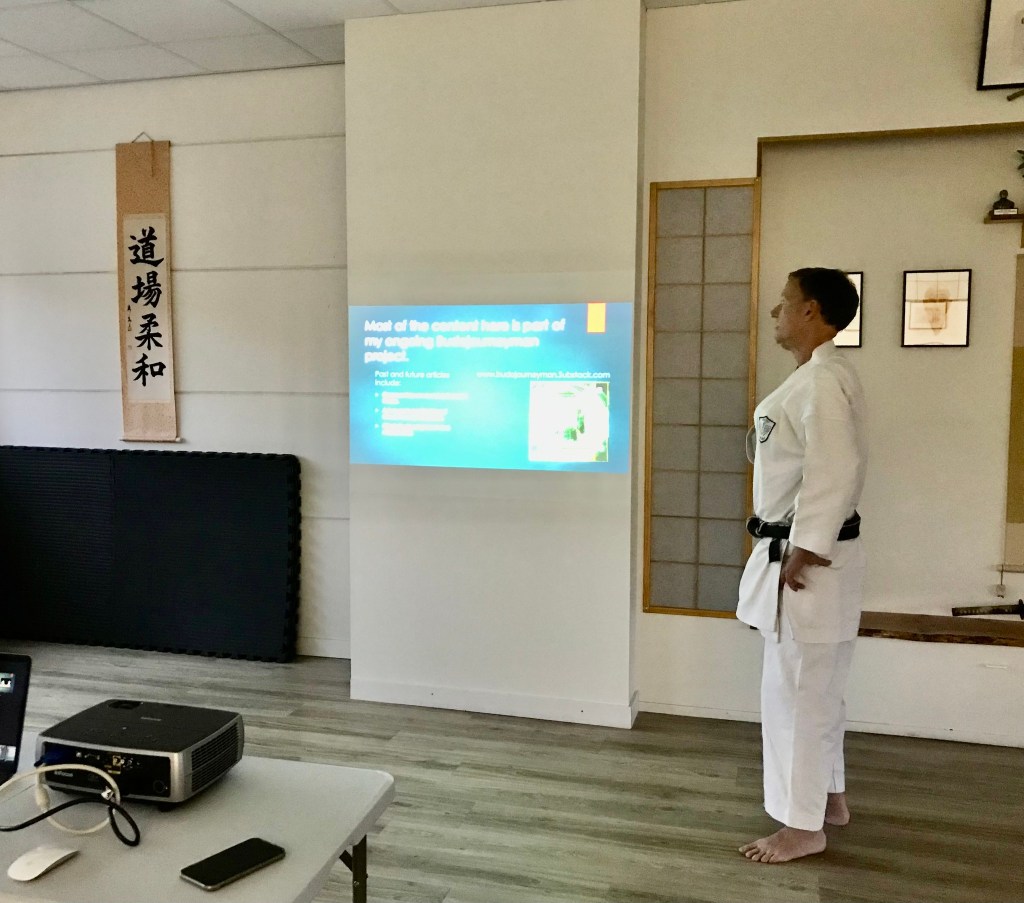
On a previous course in the Netherlands, I had organised for an after-training slide lecture using a PowerPoint projection. I wanted to do the same thing again but this time with the specific focus on the early history of Wado before it became a thing, the embryonic ideas of Otsuka Hironori that became the background for what we do now. While I appreciate that not everybody is a history geek like me, I wanted to try and open a window into the past, with the idea of shifting the perspective to try and understand what we are really doing.
Sunday training.
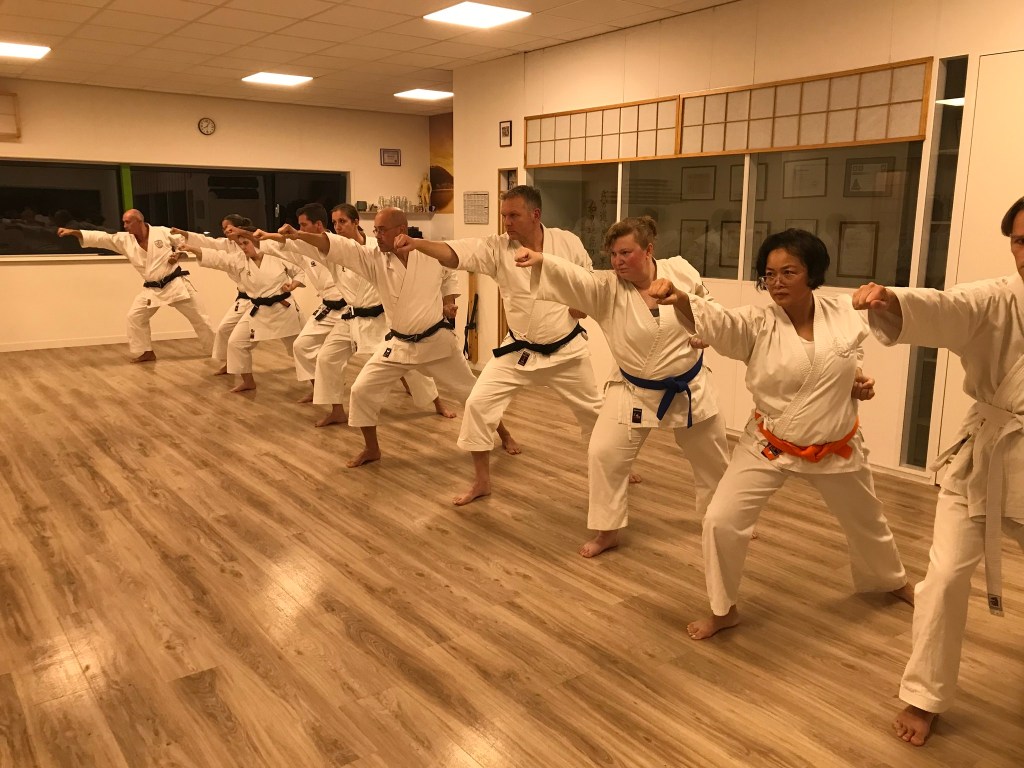
This was a day for bringing it all together in concrete practice. This is a completely different teaching methodology for me and a bit of an experiment, a high-risk strategy; but I need not have worried, the students completely rose to the challenge and pushed themselves hard. I had written on the Dojo whiteboard, ‘Just do it!’ and the runs of paired techniques flowed smoothly. I deliberately kept the techniques as core Wado methodology, so the students were not engaging with techniques that were unfamiliar to them, thus it was repeat and repeat again, all with the pressure of attacks meant it had to work. This was also where the timing issues that were addressed earlier in the weekend training came in.
At the end of the training the students knew they had been working hard, which reinforced the earlier stated aim of the weekend.
The weekend was not without the opportunities to socialise. On Saturday Martijn had scouted out an excellent Nepalese restaurant in Hilversum (a shout out to the Gorkha restaurant, https://gorkharestaurant.nl/ )
Huge thanks to Martijn and Astrid Schelen de Vries for inviting me and organising such an excellent training opportunity, and to Sue Dodd for her company and assistance throughout the weekend.
As has become routine, Hokusei Jyuku were pleased to welcome Sensei Steve Rawson 7th Dan and Sensei Pam Rawson 7th Dan back to Norway, as it happens exactly one calendar year on from their visit in 2022. And for the most part, routine and reinforcing routine was the name of the game for this now well established event in the Shikukai calendar.
The training schedule ran exactly as before with the club juniors under instruction for the first 1.5 hours of the Saturday session. Unfortunately, course attendance was adversely affected by illness this year but that certainly did not stop those that did manage to make it, getting the most out of the course.
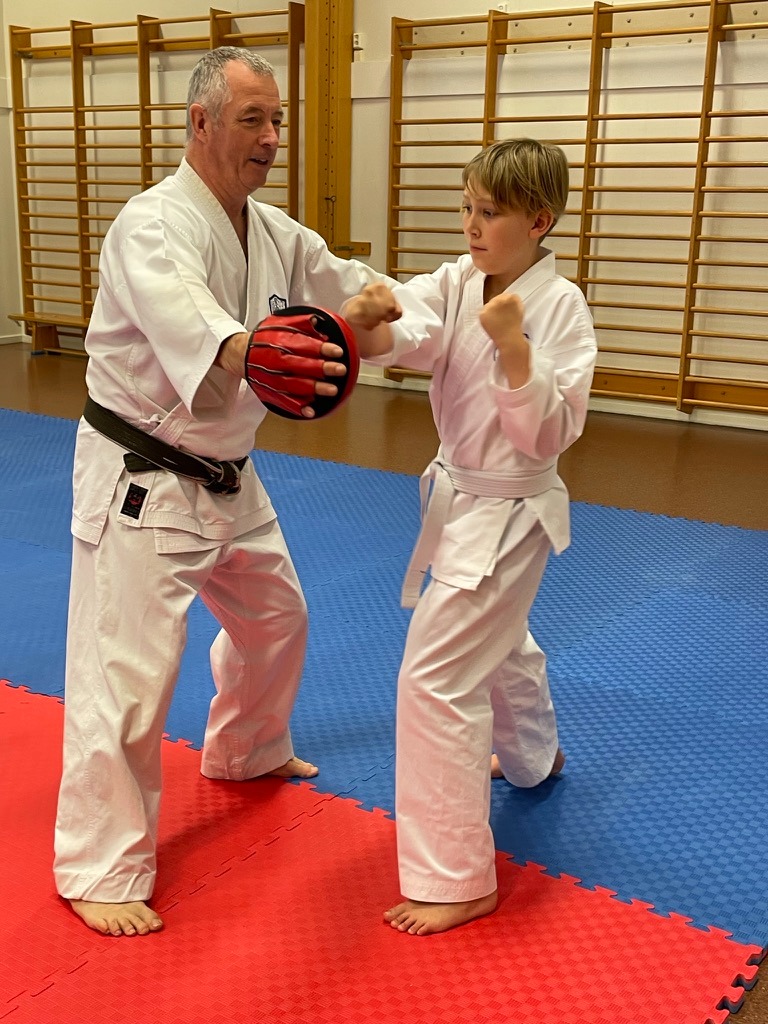
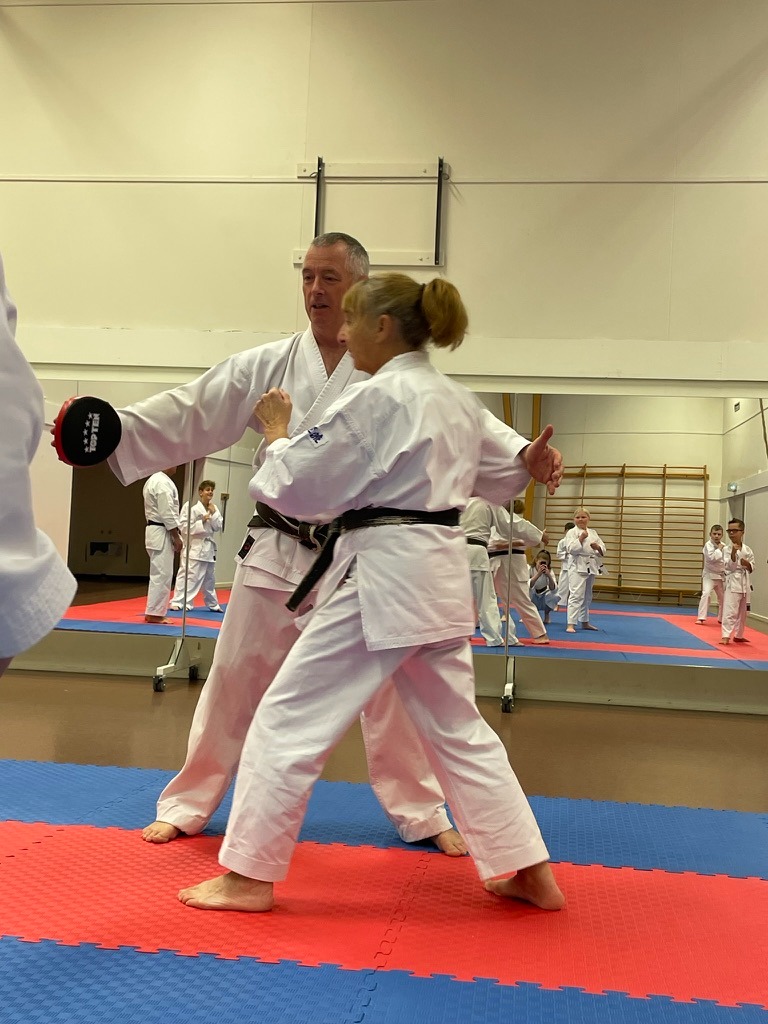
Sensei Steve set the kids off with some punching and kicking drills moving left and right 90 degrees at a time in a circle on-the-spot sequence that got them concentrating on their balance and particularly resetting in order to improve their action, with speed of course demanded. Activities then progressed to some punching practice into instructor handheld pads to gauge if the juniors had ‘titanium or fluffy pillow’ punches, and of course there were no fluffy pillows to be found.
Further drill variations gave the students the opportunity to focus on making sure that they pulled back their punches the correct amount before each in turn found themselves in the middle of the class, punching faster than whoever they had in front of them, as they faced off each fellow student. The junior session ended with instruction on Pinan Nidan for the more senior members of the group and all are congratulated on their effort and concentration throughout.
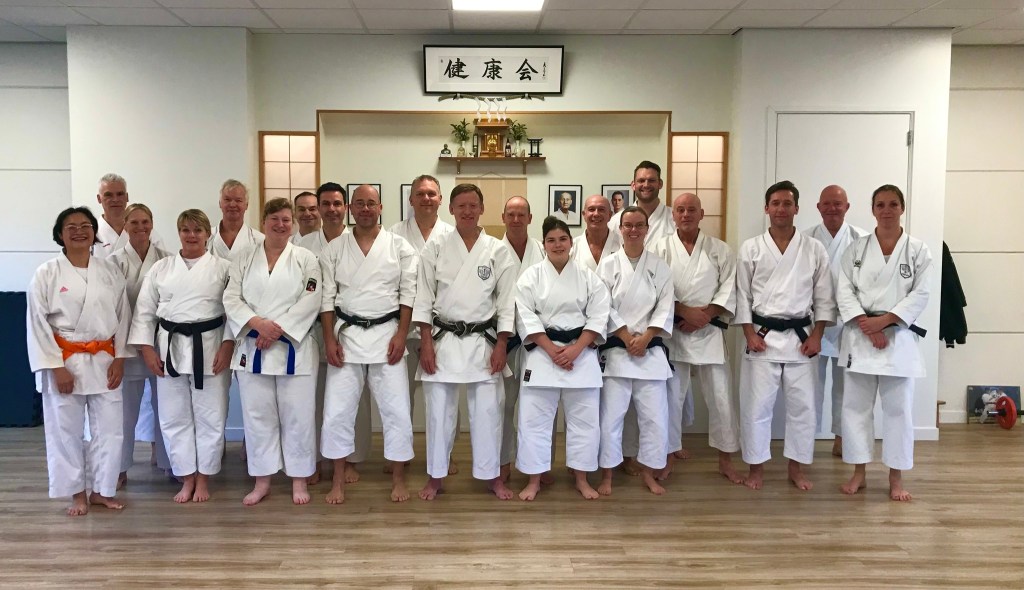
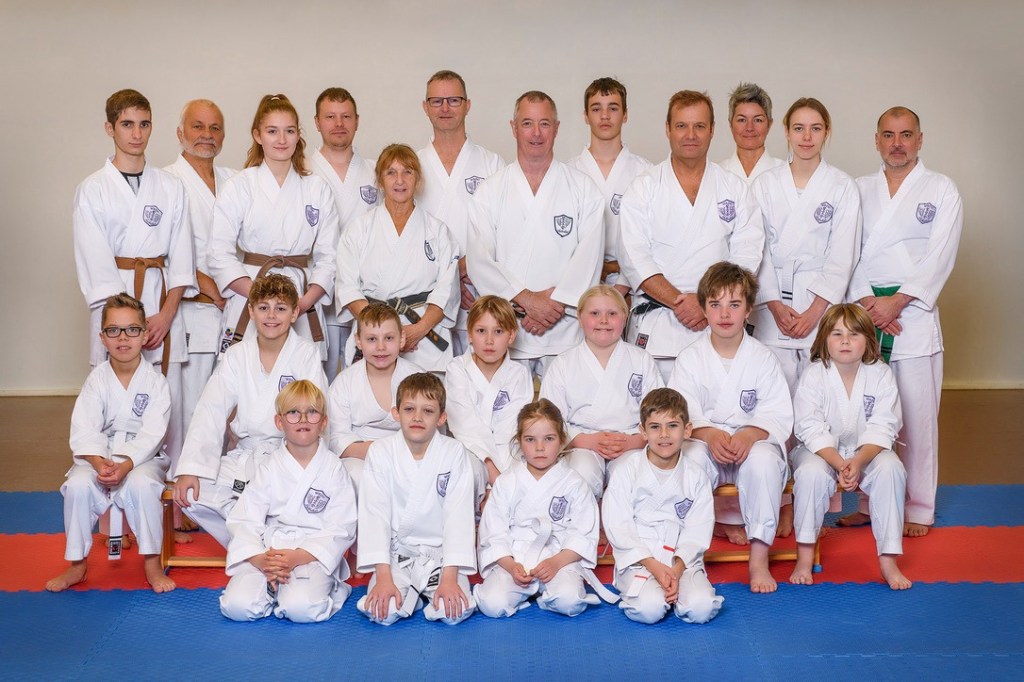
Before the adult session began there was the obligatory club photograph with parents able to take their own images of their children and meet and greet the now swelled group.
Saturday’s adult session began with an explanation by Sensei Steve on the theme of this year’s Autumn course, discussing Sugasawa Sensei’s aim at improving attacking focus when carrying out pair work kata…
Instruction began in earnest with Kihon drills, emphasising the above theme and ensuring body control was constantly being tested to improve any technique being asked for. The Dan grade basics in particular were sequenced with various points being reinforced for the benefit of all, not just the students who are closest to that level. The visiting Senseis were able to add refined detail and provide innovative drills to cure ills and improve skills.
The session then moved on to the Kihon pair work variations that were taught on the Autumn course. Not all were covered on the Saturday session but the foundations were firmly laid ready to complete them all during the Sunday session.
The session ended with Pinan Sandan making sure that the students who could not rejoin us on the Sunday maximised their Saturday attendance; followed by a wash and brush up of Naihanchi kata.
As with all courses time passes so quickly and no sooner had Saturday’s training ceased, when Sunday’s was upon us; although there was a very pleasant evening gathering at the Wymer’s which attendees appeared to enjoy between sessions…
After the Sunday warm up, basics were again practiced before some extra beneficial kicking improvement drills using the wall bars were introduced. These were not totally new to the club but certainly concentrated some minds and resulted in some strange groaning noises which were interesting.
The rest of the session was taken up by instruction on Rohai, completion of the Kihon kumite pair work variations shown on the Autumn course (including the last one where I acted as a perfect dummy for Sensei Steve’s reactions to my attack) plus some additional pair work drills aimed at improving distance and timing. There was also time for some light sparring drills before the finish bell was sounded.
Interspersed throughout the instruction (and the social), Japanese terms and phrases were discussed, including Kobo no ichi and Koshi wo kiru to name but two. Sensei Pam’s extensive knowledge of not only the Japanese terms but also their relevance to our Wado technique and world, adds greatly to a student’s journey and acts as a welcome additional stimulant to the martial arts learning process.
In summary, another great weekend enjoyed by the northern outpost of the Shikukai family. We are now looking at growing the course, as discussed before that pesky COVID thing, so if you are interested please feel free to let me know.
And lastly, many thanks again to Senseis Steve and Pam for their continued support to the Hokusei Jyuku.
This year’s successful Autumn course was again organised brilliantly by Sensei Carol Chatterton of Kikuwa Jyuku 菊和塾.
Tim Shaw Sensei opened the event by welcoming all attendees and passing on Sensei Sugasawa’s apologies for being unable to attend. The overriding theme of the course was set by Sugasawa Sensei and although he couldn’t be there in person, his presence was felt through the hard work and dedication to detail of the senior instructors.
Instructors and students from Norway, Holland and across England joined together to work on the fundamental principles set out by Sugasawa Sensei.
The focus of the course was pair work. Sugasawa Sensei had requested that students were given more instruction on the importance of reacting to their opponent and not merely “going through the motions”. Working with students from other Shikukai clubs of different shapes, sizes and abilities really tested each and every one of us.
At the very beginning of the course we were reminded about the importance of moving from our core and of using the action of koshi wo kiru to generate our energy.
A strong emphasis throughout the course was placed on the correct use of Ma-ai (Distance) and Ma (Timing). Sometimes in paired kata there can be an imbalance between the focus of Tori and Uke. This course gave students both the practical skills and theoretical knowledge needed to ensure that both sides are equally focussed on gaining the best position and intent.
Senior instructors worked seamlessly as a team to constantly teach, remind and perfect students’ understanding of these principles. Pam Sensei gave examples of kobo no ichi (attack and defence as one) and reminded us of the importance of the correct use of Tsuki no San Yoso (Koshi, speed and body weight). Tim Sensei took students through a detailed explanation and set of exercises for the first section of Kihon Kumite Ippon me. This was followed flawlessly by Steve Sensei and Pam Sensei’s work with us on different variations for the second section of Kihon Kumite Ippon me.
Tim Sensei introduced the Autumn course on the first day saying that he hoped that we would walk out of the dojo with something more that we came in with…perhaps being a different karateka. I have certainly grown in my understanding of the relationship between Uke and Tori and the use of intent.
Many thanks to Tim Sensei, Steve Sensei, Pam Sensei and Richard Sensei for their team work, patience and kindness.
The following three students were successful in obtaining 1st Kyu grade:
Adam Rose (Kiku Wa Jyuku) Archie Warren (Ken Bu Jyuku) Lewis Higginson (Ken Bu Jyuku)
The August Bank Holiday training in Brittany, France is one of the longest established courses in the Shikukai calendar. The course is hosted by Mumei Juku and this year was attended by students from England, France and the Czech Republic. These guys deserve a special mention, as they drove for 18 hours in each direction to attend the training.
Instruction was provided by Steve Chamberlain 7th Dan under the supervision of Chief Instructor Sugasawa Sensei.
The overriding themes for the three days of training was to aim for softness of movement and effective use of breathing. Saturday began with a focused warm up based on controlled breathing techniques that set the scene for the rest of the course. We began with a ground-up practice of Zuki and Shuto-uke, moving slowly to appreciate the subtleties of the techniques, the tracking of elbows, smoothness of the movements, and how the breath integrates with all of this. The practice then moved on to Meoto-te (co-ordinated defensive and attacking movements) including focused paired exercises based on the format of Kumite Kata.
Several students shared a very well-appointed flat in nearby Huelgoat, and were pleased to host a get-together for all on Saturday evening. As the conversations developed, one member recounted an unnerving experience in their accommodation which as we later learned, was known to be haunted!
Sunday’s training delved into Naihanchi and Seishan kata, looking particularly at the extension and contraction of muscles (Shinshuku) necessary to perform the kata correctly. Each part of the kata was studied individually to ensure that the full range of movement was utilised, with encouragement to move outside our personal comfort zone, but at the same time within the constraints of our own body. This level of awareness when performing the kata added an interesting dimension to the practice.
The practice of Seishan kata focussed on the use of elbows (another overarching theme for the weekend) and the connection to tanden. As a test of whether we were really getting it, we practiced in pairs to feel the effectiveness of the technique from the perspective of both Tori and Uke. It was interesting to have the opportunity to practice with different partners.
The Shikukai family came together again on the Sunday evening and enjoyed a feast including a speciality bean stew prepared by the students from the Czech Republic
Sugasawa Sensei led the final session of the weekend, with a practice of the muscular and biomechanical aspects of Koshi wo Kiru. Once the details were translated into movement we were able to appreciate how this felt, and the benefits of this way of operating were immediately evident. Then, in complete contrast, the remainder of the session consisted of a run-through of all Kumite Gata in fast succession. Was the hidden agenda here was to test whether these kata could be performed with correct Koshi wo Kiru? Maybe!
After the training, those that did not have to start their journeys home right away, made a small excursion to a nearby beach providing a chance to enjoy a fine late-summer’s day and take in some fresh air.
Feedback from the course was very positive and as a testament to the quality of the course all students have already booked to return.










 Shikukai Karate-Do International