It was decided to hold this Course in two parts; firstly there was a lot of content to cover and secondly the two different venues made it easier for students’ journeys.
Part 1 in January was hosted by Kenbu Jyuku at The Osprey Leisure Centre, Portland while Part 2 was held in March at The Olympiad in Chippenham and hosted by Kiku Wa Jyuku.
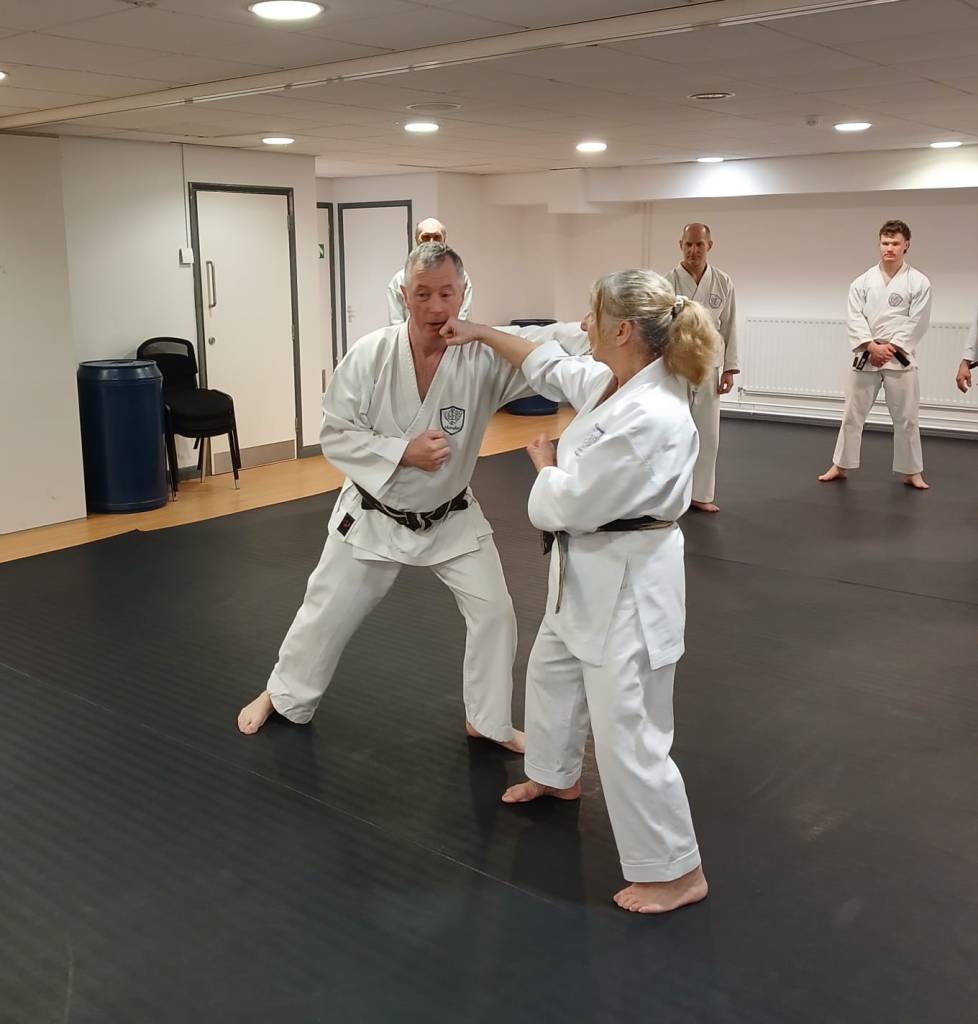
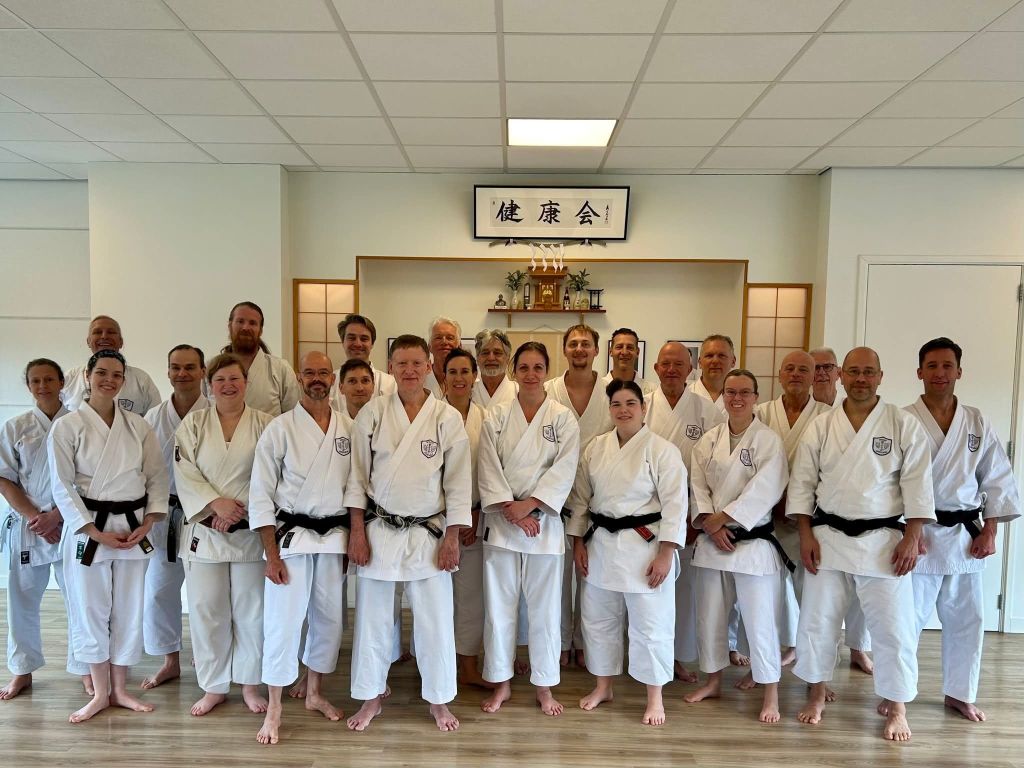
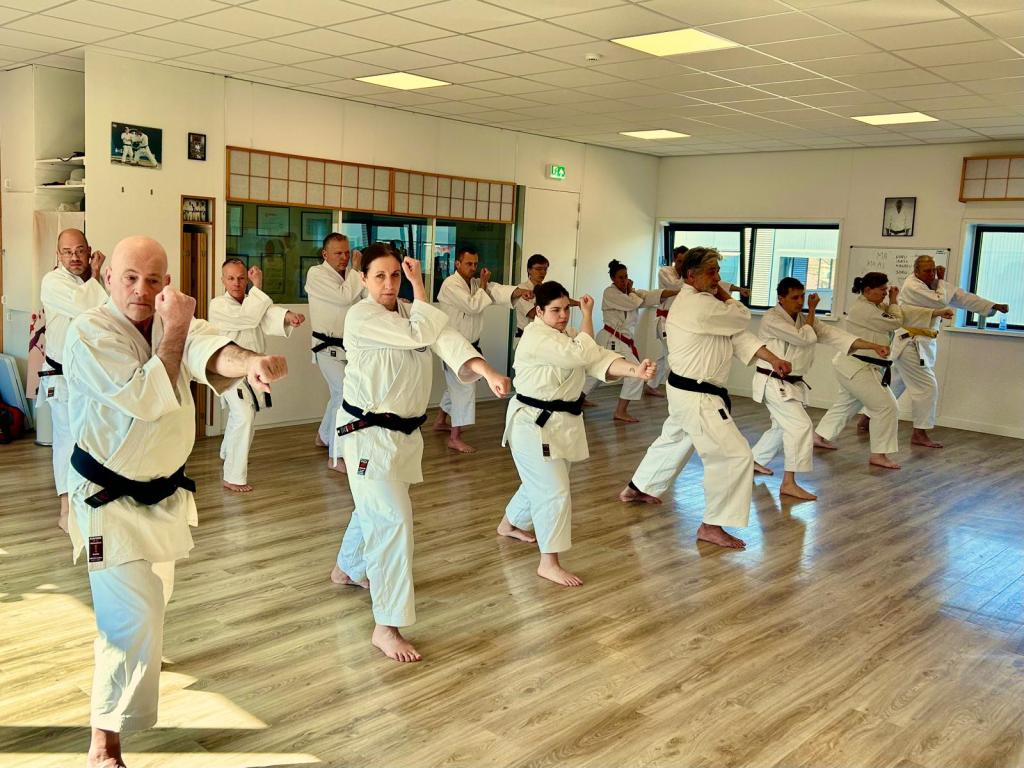
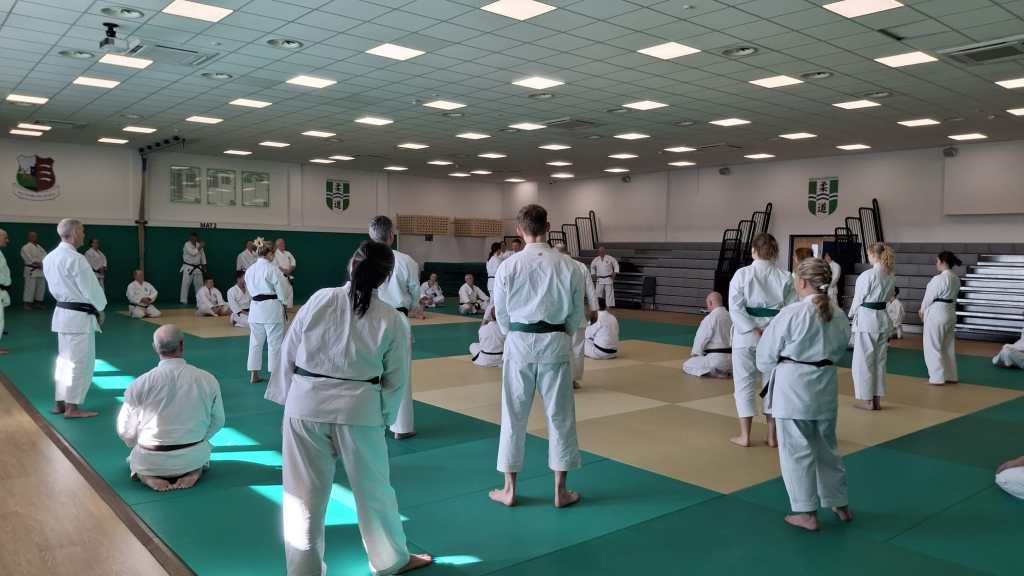
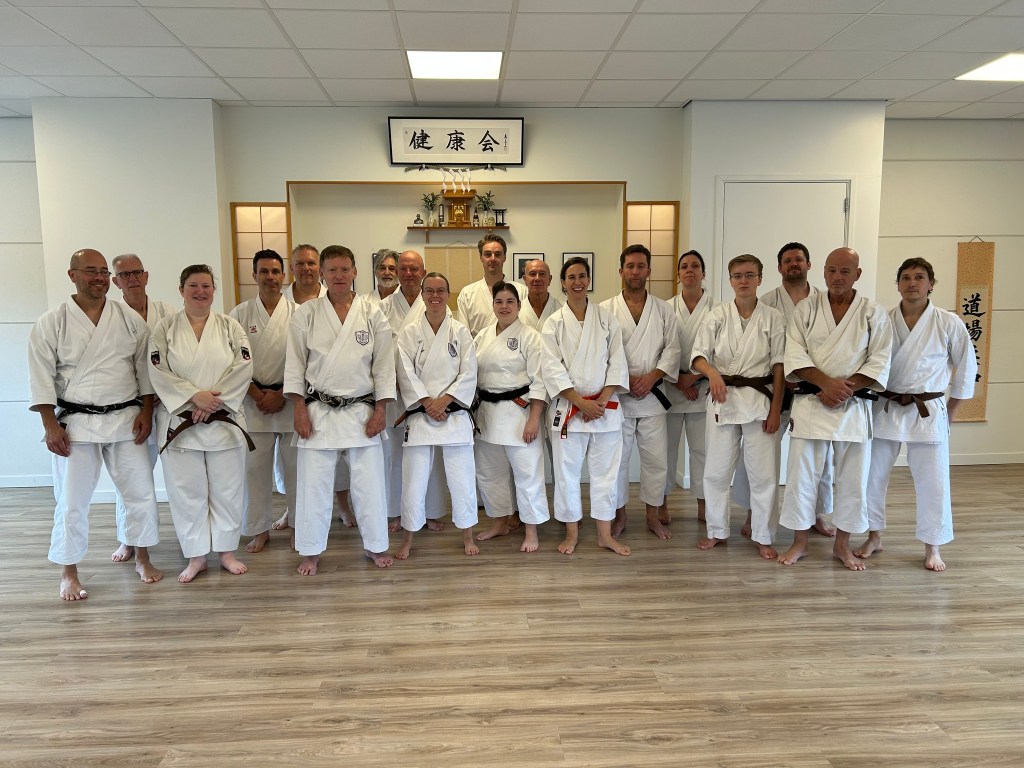
Around 25 karateka attended on each of the sessions, including students from Kenbu Jyuku, Kiku Wa Jyuku, Mushin Jyuku, Showa Jyuku, Zendo Jyuku and Seido Jyuku. It was explained to the students that Ura No Kumite are the forerunner and building blocks to modern syllabus pairworks and showing the importance of Seichisa 精 緻 さ (Precision) and Shogekido 衝 撃度 (Impact).
The two parts followed the same format, beginning with a short warm up and some basic techniques. Part 1 covered the odd numbers and Part 2 the even numbers, thereby dealing with all the 24 over the two sessions. The main advantage of having a large group of students from various clubs meant that everyone could work with partners of differing age, ability and size, ensuring the necessary adaptions had to be factored in.
Ohtsuka III released his video showing the 24 Ura No Kumite several years ago, and it was interesting to show the students how the various techniques relate not only to the Shikukai syllabus but also pairworks from various other syllabuses that have been taught over the years. The longer a student had trained, the more relevant this became.
Several students commented on having a “lightbulb” moment when they made the correlation between a particular syllabus pairwork to it’s building block from the Ura No Kumite. It is hoped that the course was able to get students to think a little bit “out of the box” in how pairwork is constructed and practised.
Steve & Pam would like to thank everyone for attending and for the effort and enthusiasm they put in.
Spring sunshine, but bitterly cold evenings, in both the UK and the Netherlands. But Ryanair and Dutch immigration held a couple of surprises for me, nothing big, just minor curiosities. To start with, the airline has gone totally digital now, no great shakes, but then the Eindhoven passport officials surprised me by needing biometrics, including fingerprints, but I wasn’t going to let it ruin my weekend.
The training.
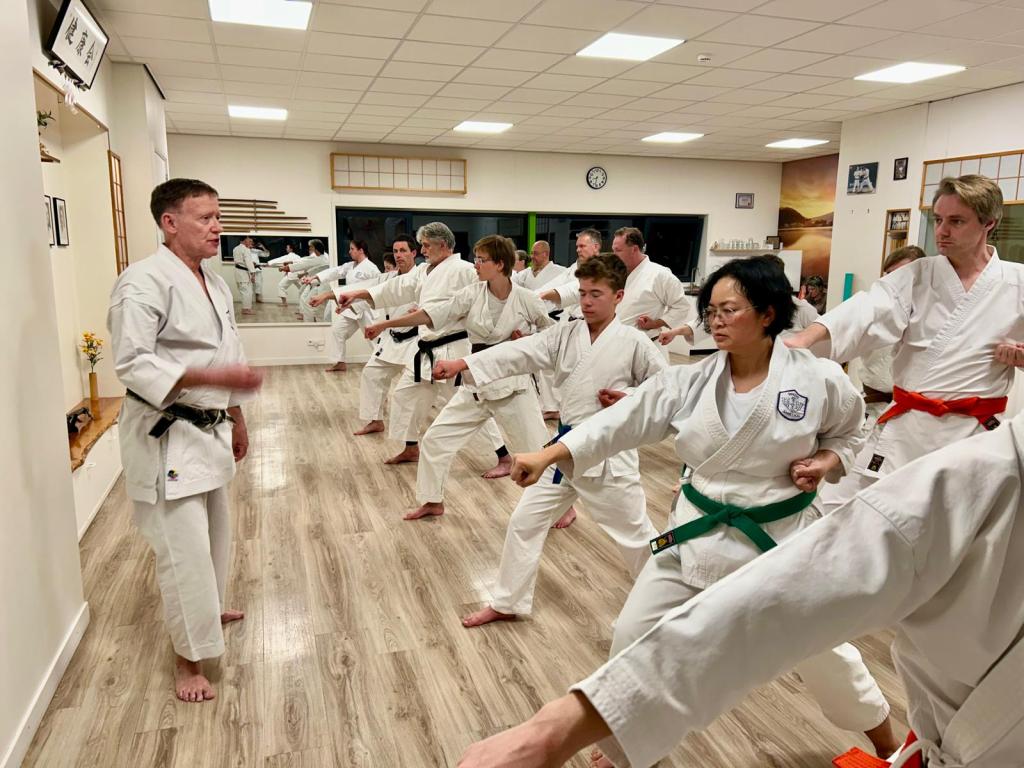
It was indeed a packed itinerary. My teaching schedule was nine hours of Dojo time. Course organiser Martijn Schelen de Vries and I had got our heads together and set a loose agenda for the various workshops. Everything went pretty much to plan.
Friday.
As expected, the late Friday training was very much an in-house event. Many regular faces, veterans now of courses in the Netherlands and visits to the UK. All of this establishes continuity and growth.
Shikukai in the Netherlands has picked up even more new members and it was lovely to meet up with Ronald Rennes again and the seniors from his Dojo. Ronald goes back many years with Sugasawa Sensei and is keen to embrace the Shikukai methodology.
Friday featured very active working on depth of attack and instant reaction. Timing coming out of judging distance and rhythm of attack through sharply attuned senses. That way a simple drill can become really charged with powerful intent.
Saturday.
I had factored in a number of threads that were woven into the training and picked up at various points. Very recently Sugasawa Sensei had highlighted, if not a missing element, but maybe something that is too lightly skipped over. This was his insistence on the acknowledgment of ‘interval’ as related to timing in both solo kata and fighting.
We visited this on Saturday and Sunday where the solo kata focus across the two days was Pinan Sandan, which, in my mind, is an excellent vehicle, with its spaced intervals and continual changes of emphasis.
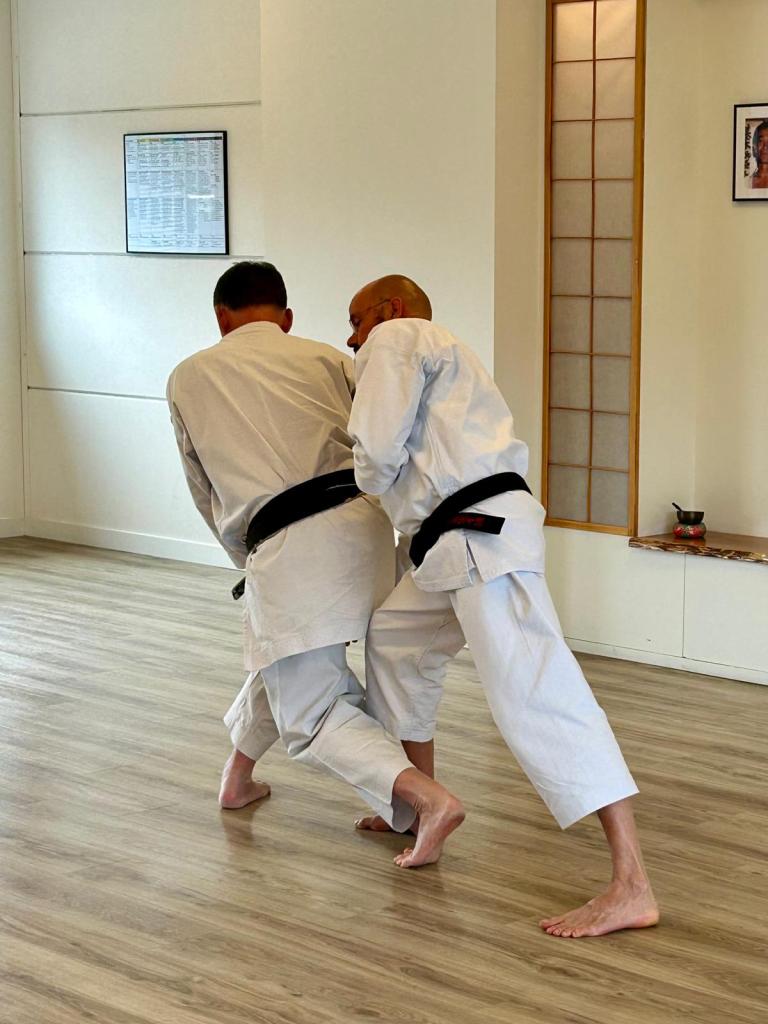
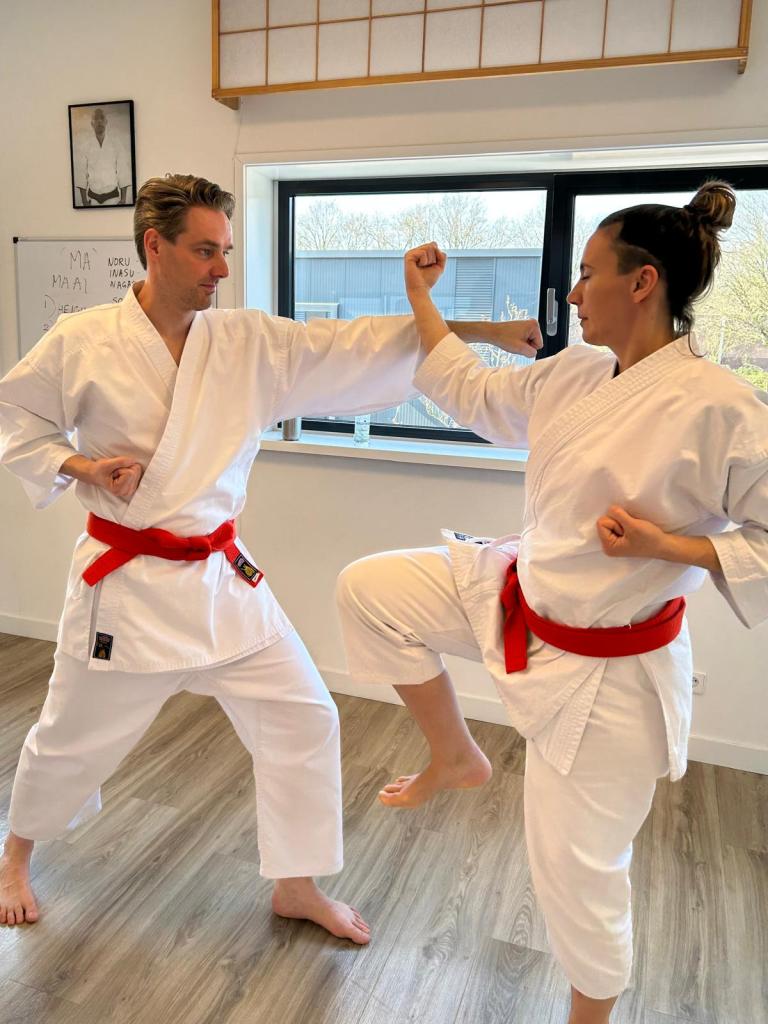
As is frequently the case, we inevitably went into the paired kata. The kumite gata needed a forensic dissection, because it is too easy to cut corners and fail to acknowledge what is really going on. (This came out of Martijn and I engineering it so that we were able to give further detailed feedback to the two recently successful Nidan candidates. We did this through reviewing a video of the grading and collected sets of notes – all really useful stuff).
Lecture PowerPoint.
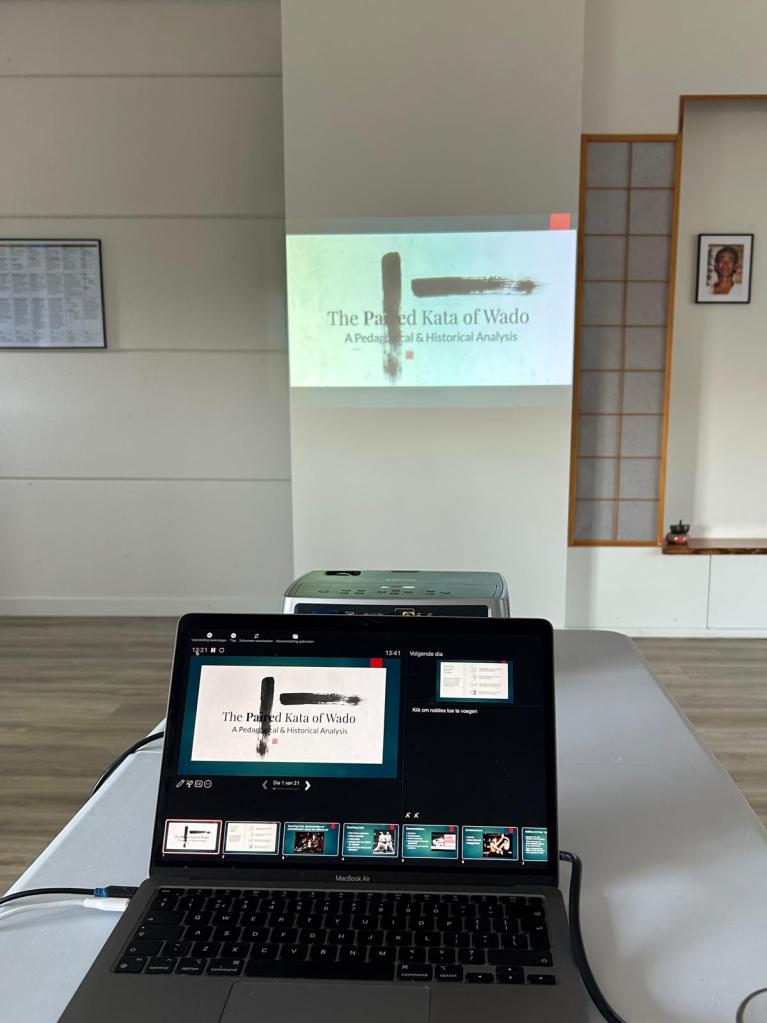
At the end of Saturday training, it had been organised for me to present a PowerPoint lecture explaining how the paired kata of Wado were structured, with the idea that students would gain greater insights into how it is supposed to work. This was well received and opened up a dialogue which hopefully dispelled some of the myths and assumptions floating around.
Throughout the training, I always work to present suitable challenges to the junior grades (I am aware that often this course get a little ‘top heavy’ with Dan grades). But on the Saturday they were able to experiment with the various options contained within the single flowing combination in the middle of Pinan Sandan.
Sunday training.
Sunday, the final day kicked off with a gentle lead into something that unfolded into a paired, coordinated drill that meshed the demands of simultaneous attack and defence. Difficult to describe, but it put the individuals in a position of safety then imperceptivity strayed into an area of jeopardy. All very safe but I like to think that some valuable lessons were picked up. Also, it was one of those drills that could be adapted to create other equally valuable variants.
Extra-curricular.
The weekend was not all about the sweat and toil of the Dojo.
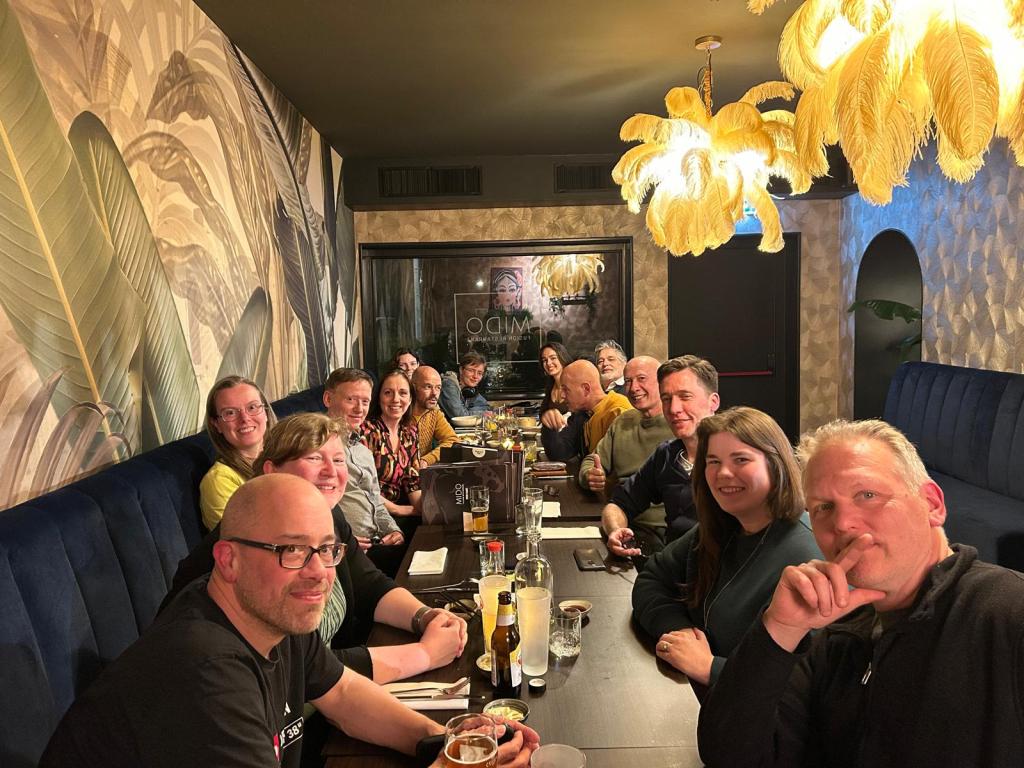
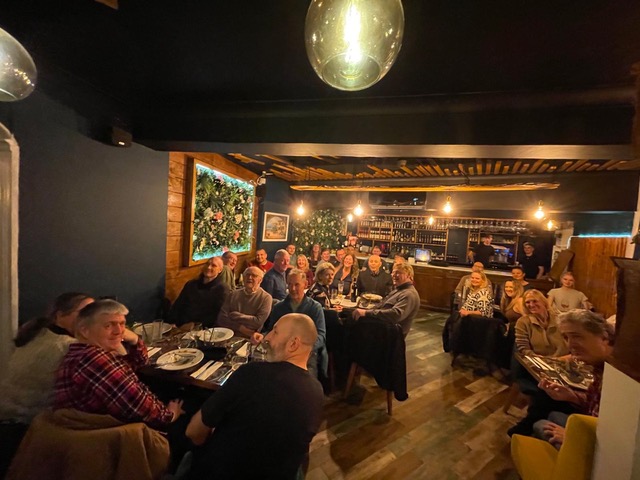
There was the opportunity for everyone to get together in a very well selected Asian Fusion restaurant, called Mido, in central Hilversum. The menu was a real surprise, made up of a continual roll out of rather excellent dishes.
As usual, across the weekend, everything was super-efficient, all put together by hosts Martijn and Astrid Schelen de Vries, to whom I am always immensely grateful. We have plans in place for another course for October later this year. Please keep and eye on the Shikukai website.
I have produced a set of support notes intended for the people who attended, and the mildly curious. These are to be published soon on, www.budojourneyman.substack.com
Just a brief comment from me to provide a little context to Andrew’s report (below).
I was trying to figure out when Andrew and I first met in a Dojo setting? It’s very likely to be around late 1978, or early ’79 at the old Doncaster Judo Club on Baxter Avenue, when the parents of Andrew and Suzanne Genery established it as a hub for Wado karate, and venue for courses for so many of the then resident Japanese Sensei in the UK.
Over the next four years or so I spent many hours at Baxter Avenue attending courses and squad training.
During lock-down, with all of those Zoom sessions, Andrew re-established his contact with the Shikukai organisation though his long-time bond with ex-Doncaster students, now Shikukai senior instructors Pam and Steve Rawson. It was on the back of this initiative that Andrew and I were to reconnect. This is now the third time I have driven the arrow-straight route from Essex to Doncaster, and I am really grateful to Andrew and all his students for their continual hard work and enthusiasm.
Tim Shaw
Report.
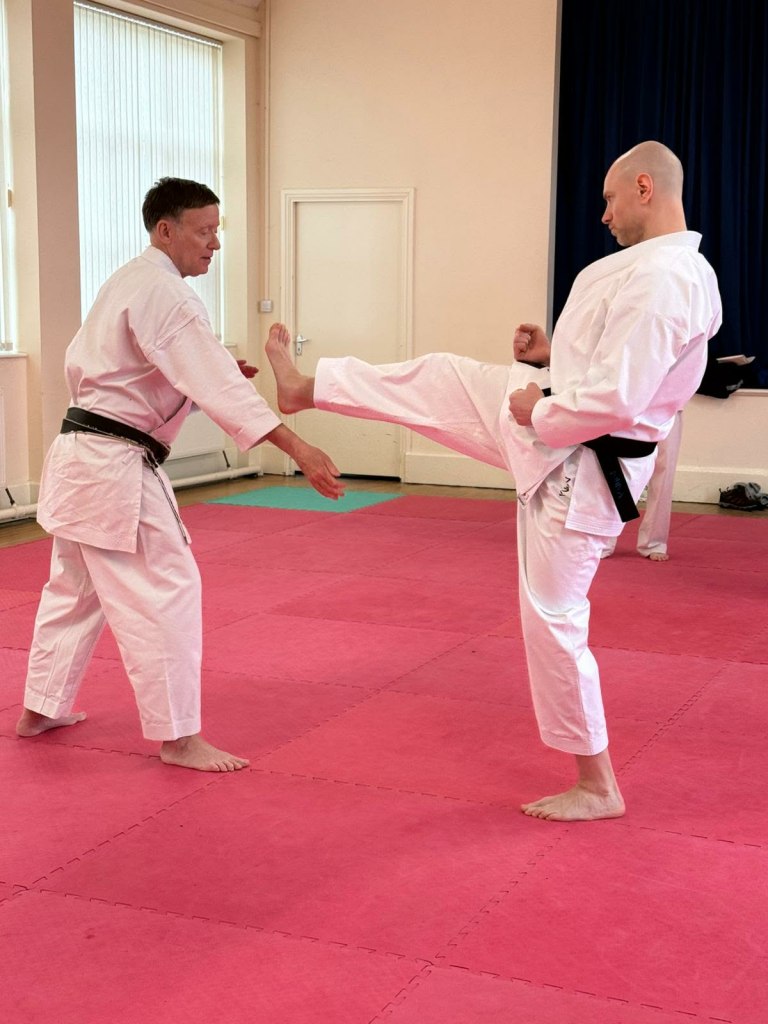
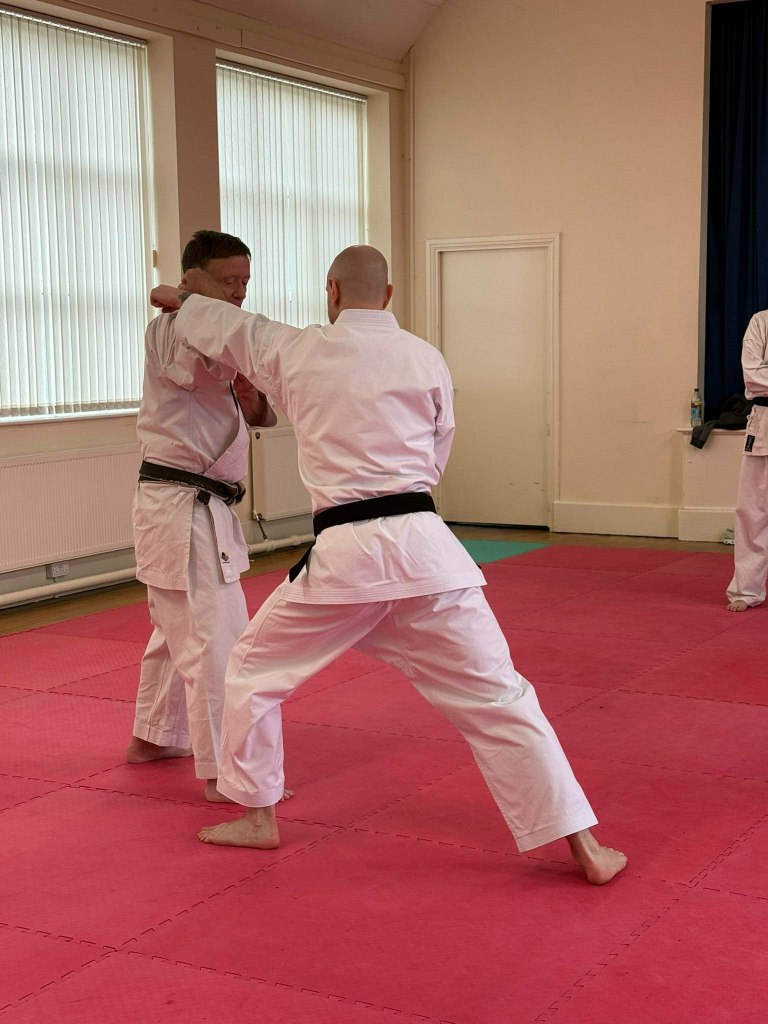
Sunday March 1st Kishinkai Wado Ryu welcomed back to the Doncaster Dojo Tim Shaw Sensei, aka The Budo Journeyman. Under Tim Sensei’s guidance we took dive into the Wado Ryu tool kit and looked at pair-work principles and Junzuki to begin ensuring the technique was performed as one move. This swiftly flowed on to looking at the correct focus of tension.
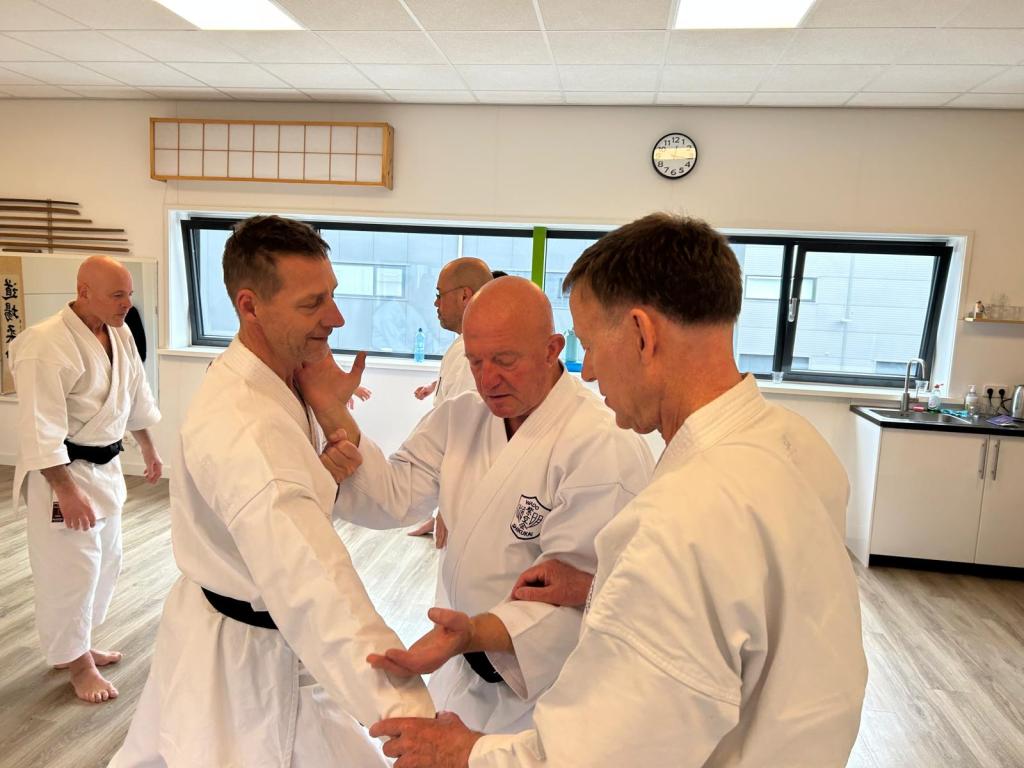
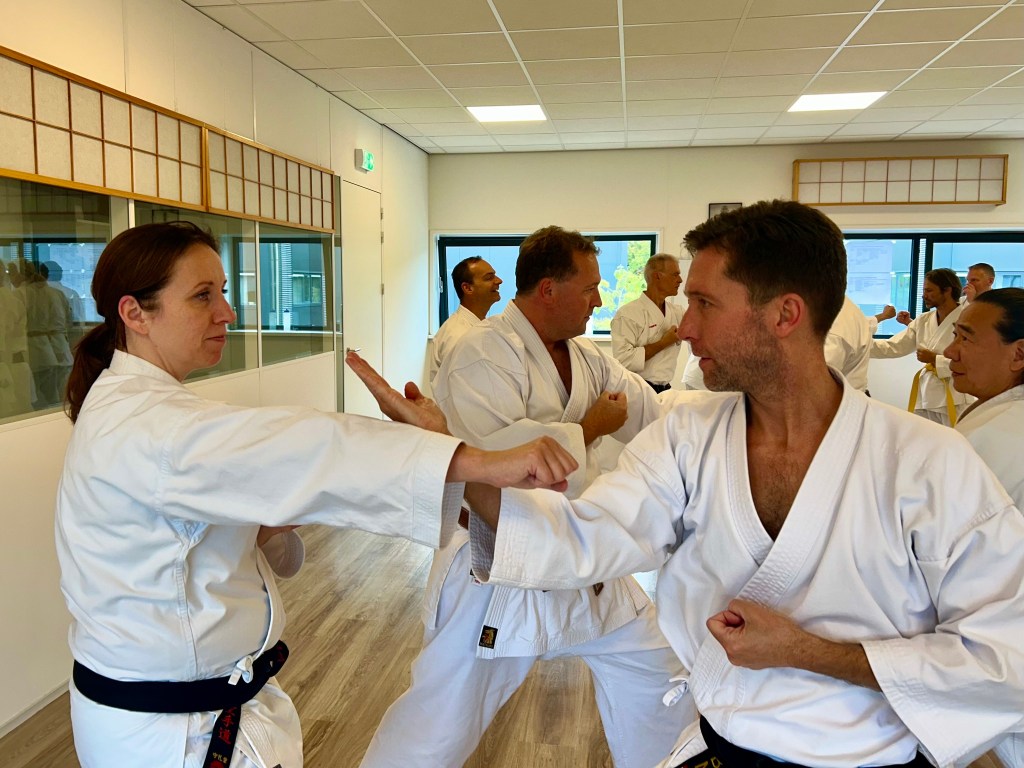
The session moved on to Harai uke and the principles behind the move, before progressing to applications and references back to kata. This was combined with naiwan (uchi) uke while defending gyakuzuki. These were put into partner drills switching the blocks from jodan to chudan. The paired drills started by taking a wider distance, to work on timing and correct techniques. The distance was reduced until it was at a minimum.
After a short break, the session moved on to kihon kumite 2 and 6. The key fundamentals were covered, including aspects such as Go No Sen, disruption, taisabaki and distance, as well as the importance of correct attacks. Thank you to Tim Sensei for sharing his vast depth of knowledge and the students who attended.
Andrew Genery, Chief Instructor, Kishinkai Wado Ryu Karate.
Running courses in the coldest season of the year is always a risk; you just don’t know what the weather is going to throw at you. The organisers always nervously eye the forecast. In fact, in all the years we have been running the Shikukai Winter Course in Essex, we have only had a couple of occasions where things became a little sticky. One for an unexpected fall of snow, and the other for a nasty seasonal storm which caused airport closures. But this year, we got lucky.
This was all good news because we were on target for topping our highest attendance for our annual seasonal Kangeiko (Winter training).
Location.
This is our second experiment with running the course in Bishop Stortford; which is looking like an ideal location, on many fronts. This includes, proximity of London Stansted Airport, the rail links and training located at two excellent venues across four days. All of this ticks so many boxes.
The train connection to London is very slick and at least one visitor from abroad took the opportunity to have a day in town (to catch the rather excellent ‘Samurai’ exhibition at the British Museum).
We had participants from Hungary, The Netherlands and France, as well as from the further north of the UK (Doncaster and Scarborough). With this being an open course, not all participants were members of Shikukai Karate-Do International. These courses are intended to inclusive and to engage with the wider Wado community, irrespective of politics.
The training.
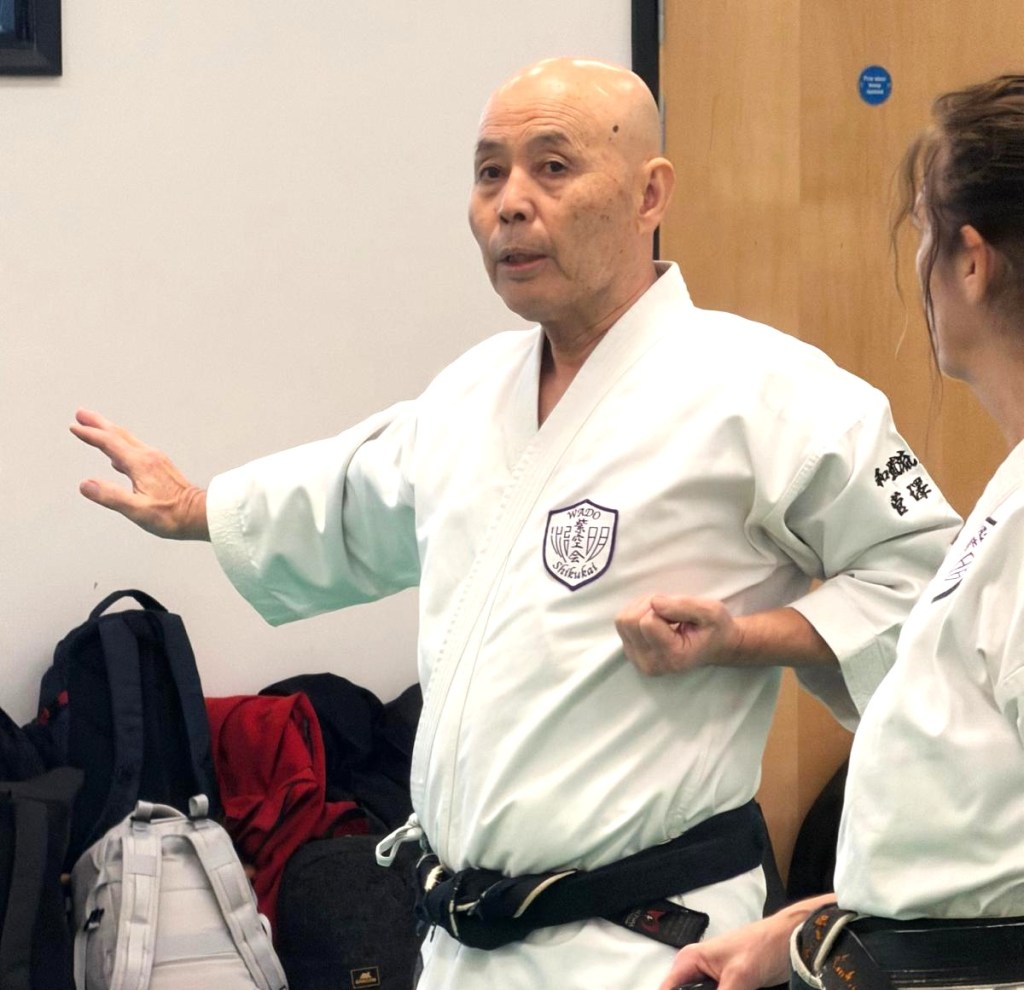
All training was directed by our chief instructor, F. Sugasawa Sensei 7th Dan. The main drive of the training was put into the hands of the very able and experienced senior instructors, with Sugasawa Sensei picking up on the correct delivery of techniques and interjecting to ensure that everything stays on task.
According to Sugasawa Sensei, the three main course across the year (Spring, Autumn and Winter) are the opportunities to establish the core themes and principles and make sure everyone is fully onboard. For this particular course the overarching subjects for Sensei were to fully utilise our observational faculties; to be able to spot good practice (or even bad practice) and adjust our techniques appropriately; hence the junior grades were encouraged to watch the seniors very closely.
Sensei also wanted us all to constantly review where we had come from, ‘two steps forward, one step back’, to always revisit aspects of our earlier training, not assuming that everything is in place.
It is impossible to catalogue everything we did across the four days of training, as so many plates were all spinning at the same time. But, needless to say, there was a solid base of Kihon and solo kata, including Pinan kata, Kushanku, Naihanchi, Jion, Jitte.
There was time spent on paired kata, including for the advanced students, the bigger throwing techniques included in Kihon Gumite 5 and 10. This was made so much easier because the centre at Bishop Stortford was totally matted-out, so, in addition, we took the opportunity to recap on Ukemi waza, with the emphasis on safety.
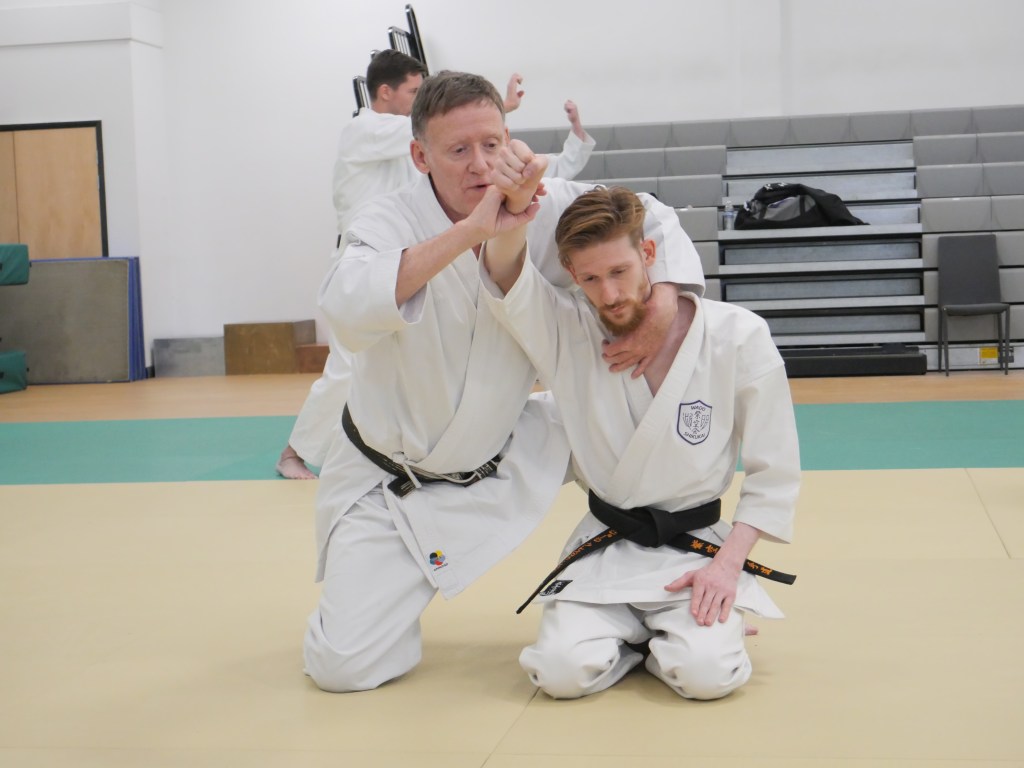
In the extra hour on Saturday, students were given the opportunity to explore the kneeling defences of Wado karate, the Idori. This particular series included kansetsu waza and shime waza.
Extra-curricular.
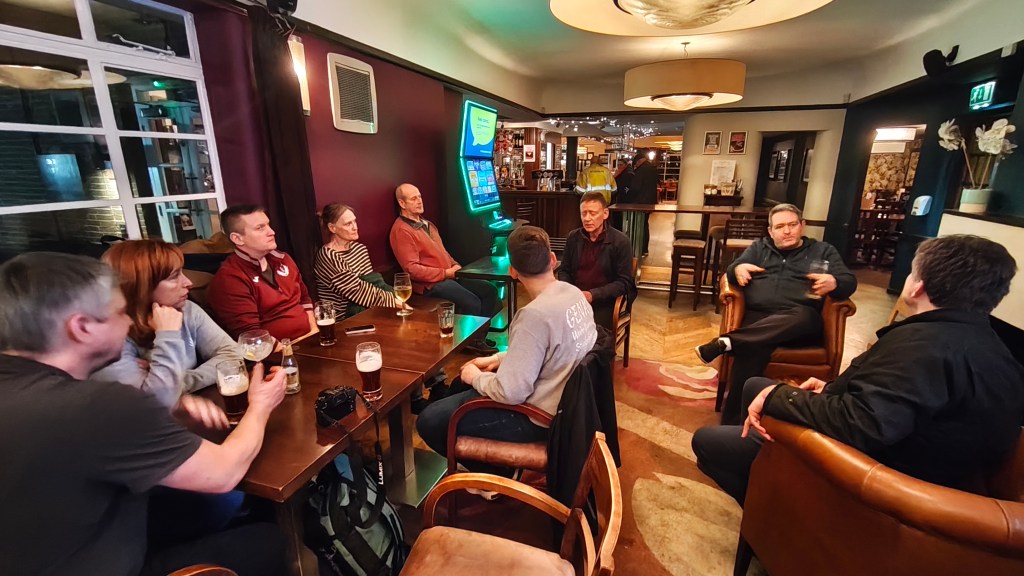
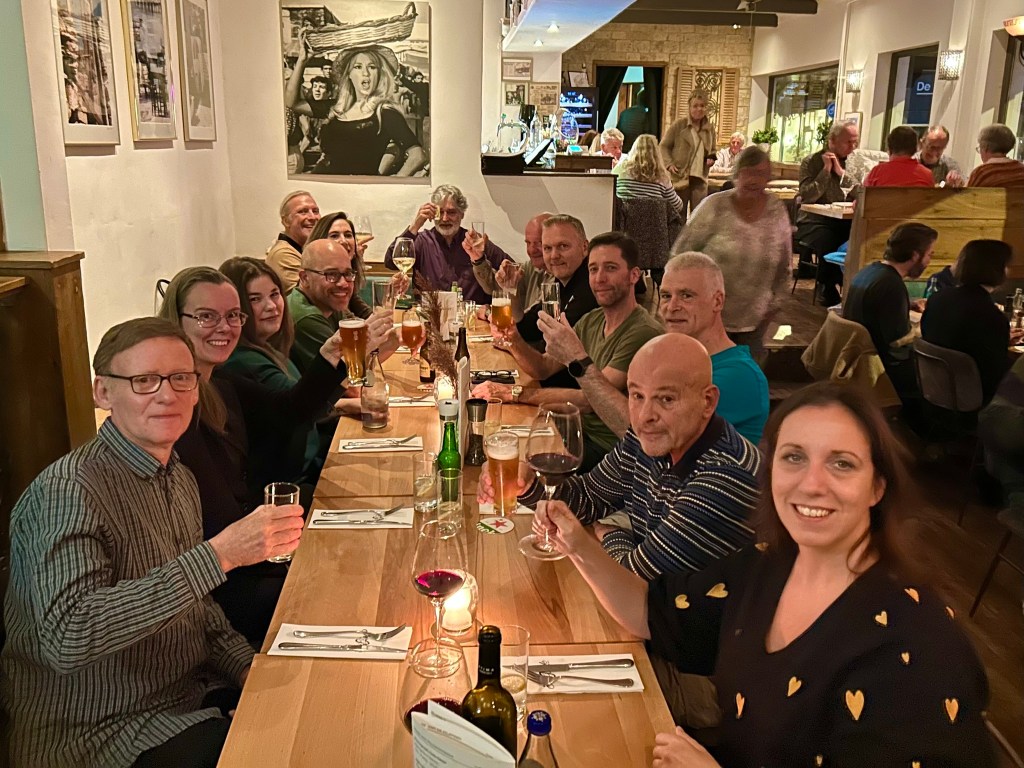
There’s always time and space for getting together socially, with the visiting of various hostelries and eating establishments. Big thanks to Kelly Cavaciuti from Chippenham for securing an Italian restaurant on a busy Saturday evening (with it being Valentines Day as well) where many of the course participants met up and a good time was had by all.
On the subject of thanks…
Massive thank you for the Chelmsford team, captained by Steve Thain. This is for all of the many lifts, airport runs, venue to hotel runs; organising locations, timings, costings, catering (Alex and Jenny Clarke for the cakes) and so many other tasks which all go to make a successful friction-free course.
Senior instructors: Gratitude to Pam and Steve Rawson Sensei, Richard Barham Sensei, Rob Selby Sensei and Carol Chatterton Sensei, all freely and willing shared their combined decades of experience within the training.
Also, thank you to Sugasawa Sensei who continues to direct our progress, keeping a steady guiding hand on quality control and acting as a general inspiration to Shikukai members and supporting groups.
A last big thanks to the most important members of this shared enterprise; all of you who turned up to train. The equation is simple; ‘no participants’ equals ‘no courses’. Everyone is incredibly grateful for the success of this combined effort.
Saturday 10th January 26 saw the Shikukai Karate International New Year training for all students being hosted by Kiku Wa Jyuku in Chippenham. Training was taken by myself and Pam Rawson Sensei 7th Dan. Sugasawa Sensei had to send his apologies due to him recovering from an eye procedure that was offered to him at very short notice.
Once the formalities and greetings were over it was recommended that all students set themselves an achievable goal for the year. That could be anything from taking a Dan Grade, to learning a new Kata etc. – stressing how important it is to strive to achieve their goal.
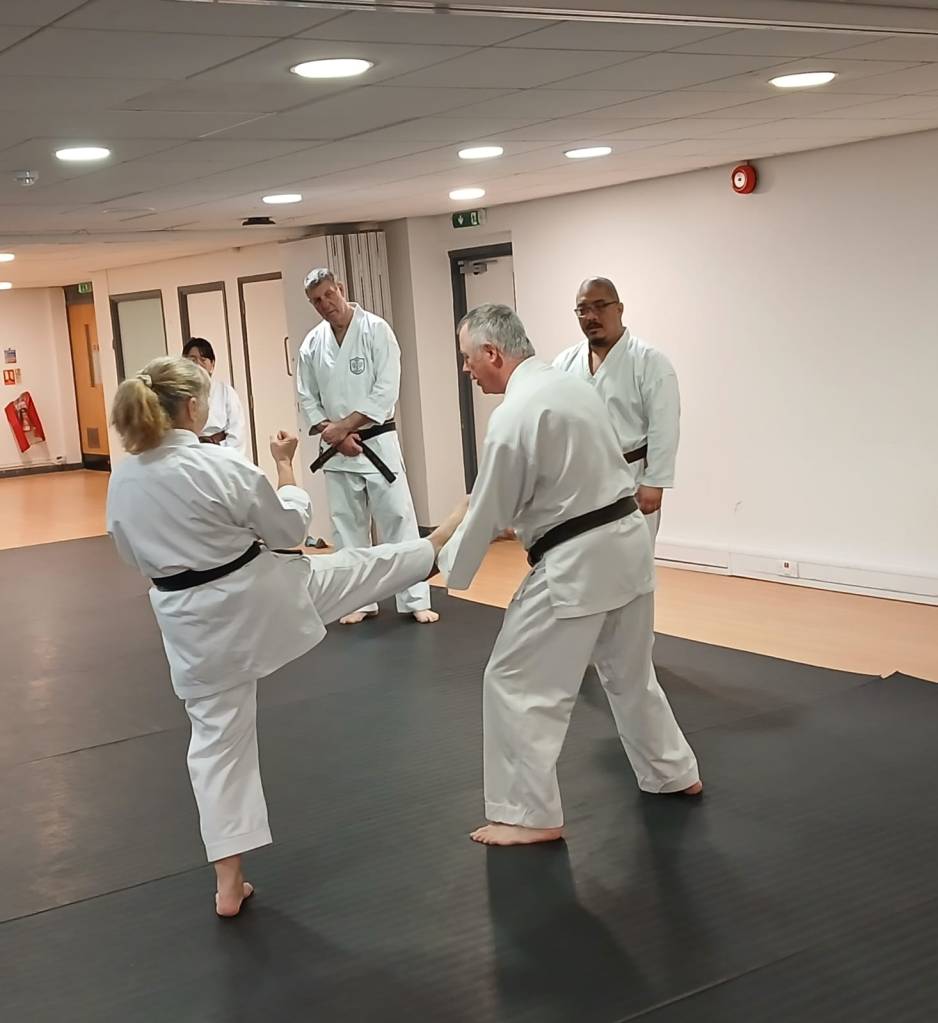
Pam set the theme of the training to be Seichisa. She went on to explain what each Kanji meant and how when they are put together it translates into “precision”. The example given was don’t just punch at the Chudan Area but try to be as precise as possible down to the last mm of accuracy.
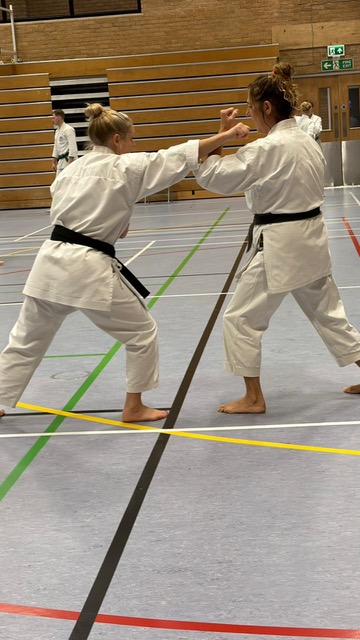
The first half of training was back to basics, Junzuki, Gyakuzuki etc but with the added difference of changing the striking point. This made students have to think about their stances whilst punching a different target area.
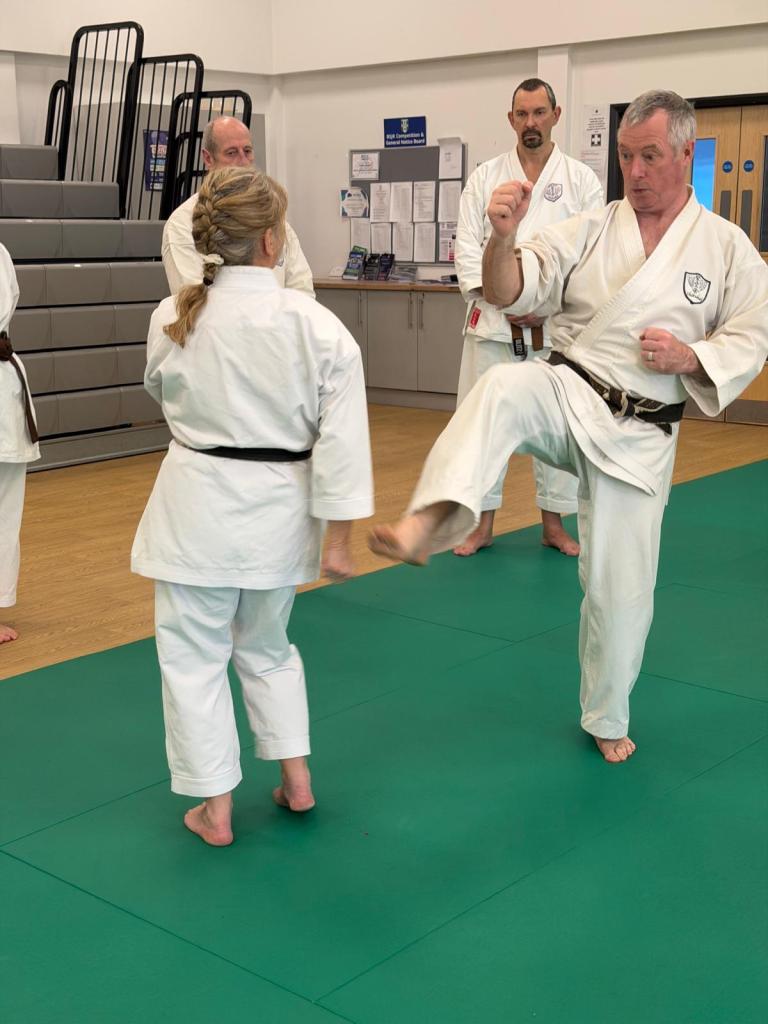
After a short break “precision” was still evident in a practical sense as the students then worked on grade appropriate Kumite Gata. The students were also encouraged to explore for themselves how important it is to be able to adapt to different opponents. This stopped them from being comfortable with the same partner as they always work with.
To finish, the students were shown a non syllabus Kumite Gata where the importance of timing was paramount.
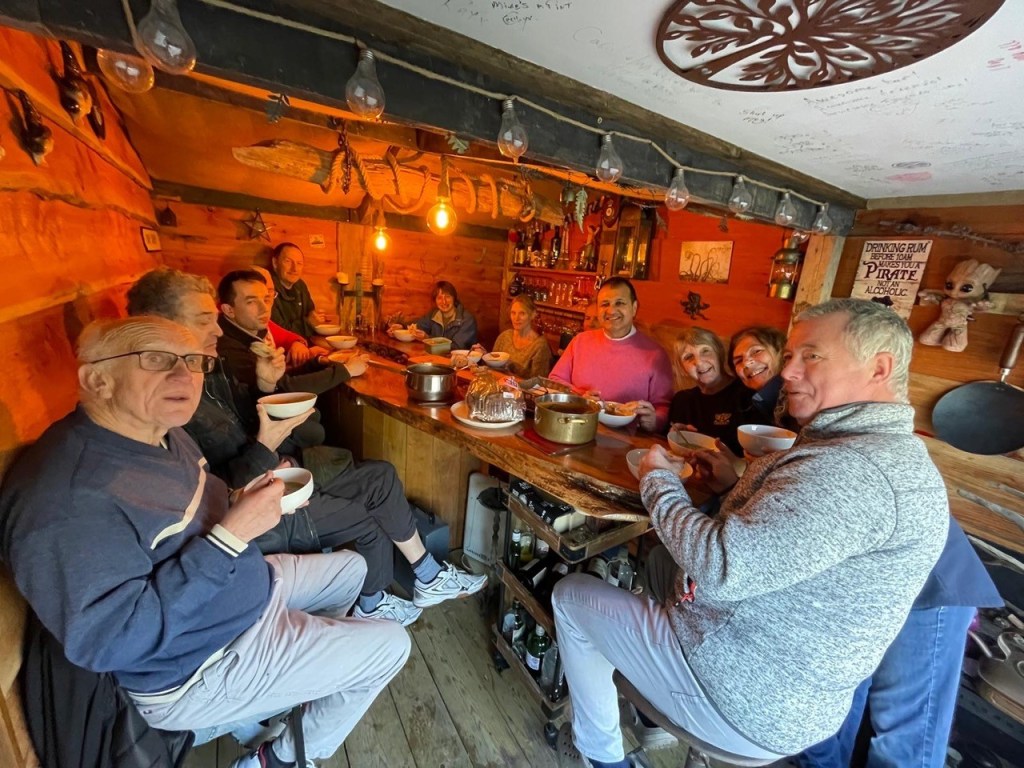
Once Karate training was finished Club Instructors were invited to Foxham to undertake their annual First Aid Training. Refreshments were very kindly provided by Carol Chatterton Sensei 6th Dan. This consisted of soup and a very nice Rum infused fruit cake!
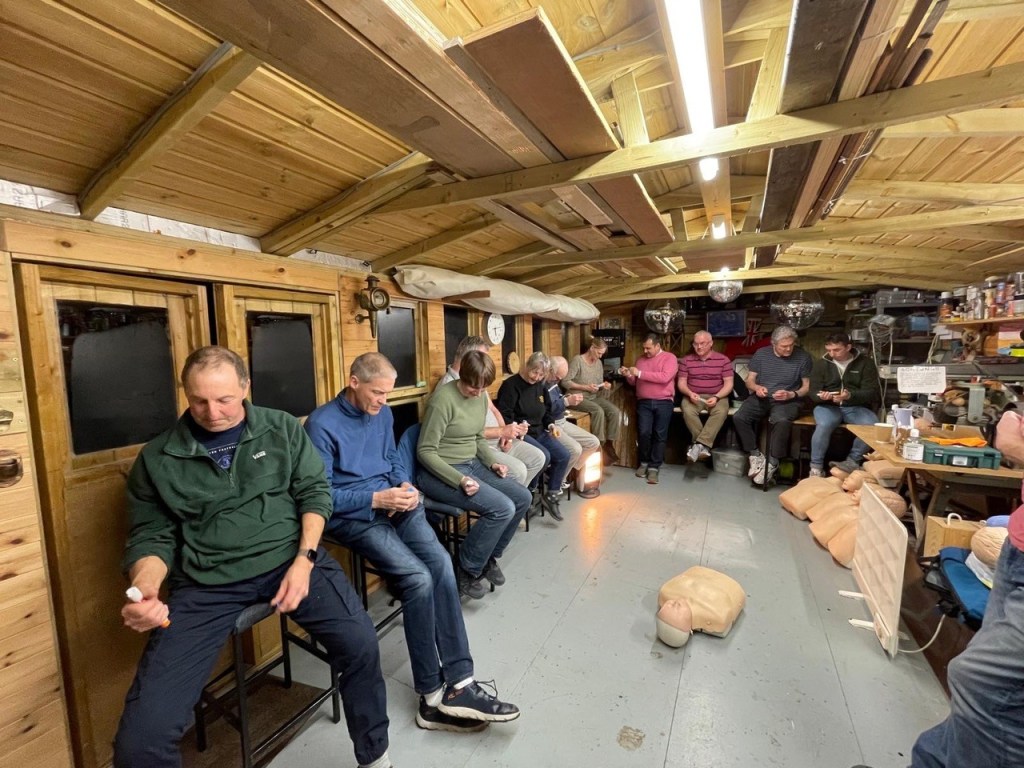
Carol’s husband Ian then spent the next three hours instructing in his unique way the now updated ways of performing CPR and other life saving skills. Competition was fierce for the box of chocolates with three students achieving 99% efficiency on the electronic Chest compression dummy. Ian congratulated them on how well they had done, especially as he recently taught at a Doctors surgery to have a GP attain only 79% efficiency. The course culminated in the group being split into two teams and having to work together on two casualties who were clothed, wet and requiring defibrillators to be located and used. His final piece of instruction was to Pam Sensei and telling her when using an epipen she has to be positive but not so hard it breaks the casualty’s leg, as the bruising on my leg shows!!!!
Once again thank you to Carol and Ian for hosting the Shikukai Training and First Aid Course.
People usually visit Prague in December to soak up the atmospheric Christmas markets – which are lovely!
However, December in Prague is a time that we look forward to each year to reconnect with our Shikukai Prague family and train under the expert guidance of Richard Barham Sensei focussing on the fundamental principles laid down by Shikukai.
As usual the course was held over three days with Friday’s training being exclusively for Shikukai members and focused on pair work. The main message for the session this Friday was about creating opportunity and space for a counterattack to execute kobo no ichi – the Wado model of offence and defence working in tandem.
On Saturday we focused on the principles of tsuki. Emphasis was placed on tsuki no san yoso (the three elements of, speed, koshi and weight). Attention was also given to eliminating waza no san aku (the three mudanas: mudana chikara, mudana ugoki and mudana waza).
The session seamlessly moved on to the practice of junzuki, sonoba zuki and then junzuki and gyakuzuki variants. Kihon kata was cleverly practiced to stress the importance of a good junzuki dachi. Here our intention was also drawn to importance of relaxation – Datsu Ryoku.
Saturday’s training concluded with Kushanku Kata. Rather than initially looking at the kata as a whole we concentrated on where our energy was generated from. This was a very useful exercise as it allowed us time to feel if we were connected to our hara, to notice if we were consciously eliminating the mudana’s or if we were leaking energy.
The last day of training came all too quickly. It was a culmination, a bringing together, of all that we had learnt on previous days. We were reminded about the principles of Junzuki dachi, tsuki no san yoso and the mudanas and were encouraged to absorb these principles in everything that we do.
In pairs, groups and then as a whole some observed others (mitori-geiko) as a way of enhancing our learning. This worked well because of the of essence behind Budo. Everybody worked as a team; everybody was encouraging and at the same time was able to give constructive criticism to help move learning on.
Many thanks to David Vlk and his team for allowing us to visit once again. Thank you for your support and for the chance to train with such a lovely group of people. Thank you for your friendship and for looking after us with transportation and for the very enjoyable hospitality in the evenings.
We are already planning our trip back
Sue Dodd
Some extra words from the host, David Vlk:
Once again Shikukai instructor Richard Barham (6th Dan) was invited to Prague for the Christmas course, accompanied by Mark Gillis (4th Dan) and Sue Dodd (2nd Dan). This is the third year they have come to Prague and gave us great support and an extra zest for practice. The course is of great importance for students in Prague who cannot attend Shikukai courses in the UK. We appreciate that the course is always tailor-made; just as a tailor measures a dress, so Richard checks and directs our karate practice according to needs. A good example is that we were asked to show our Junzuki movement without any specific instructions to start with. Richard then compared us to the correct posture and timing and gradually introduced elements of execution that he would like to see. These were not necessarily new messages, but sometimes I feel like when I say this to my group, they do not hear, but everyone tried their best in front of Richard, so it was actually nice to see. Time in Prague is not only about training. Gatherings are planned also in the evenings, in the beautiful centre of Prague, where folk customs must be observed. So there was a lot of drinking and laughing, and spending time together to enjoy the company. Well, the end of the course came very quickly and we are already looking forward to 2026, when we will be happy to invite Richard to Prague again for more training in the Shikukai way.
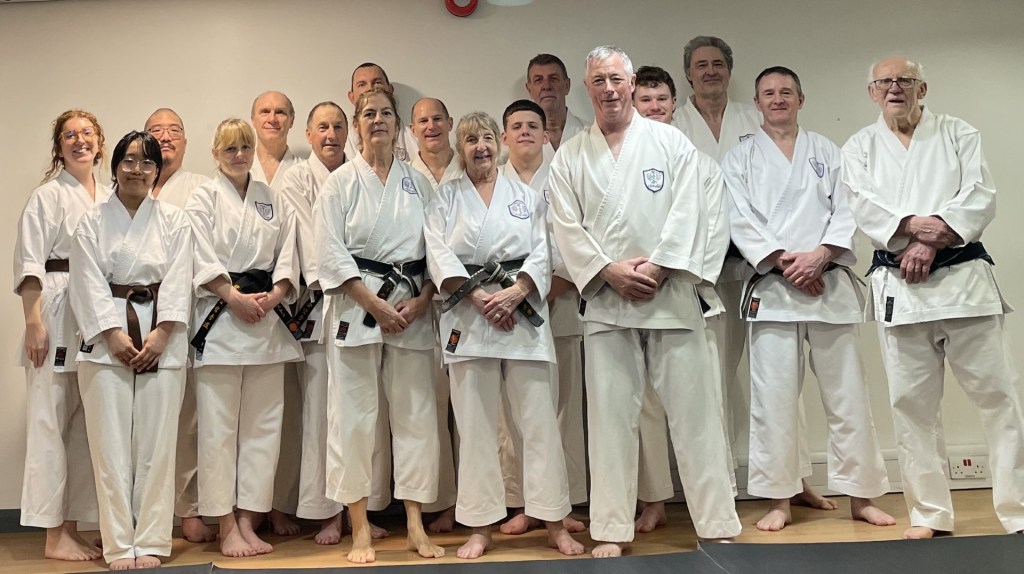
The Shikukai Autumn Course took place on 1-2 November, with Sensei Carol Chatterton 6th Dan and members of Kiku Wa Jyuku in Chippenham welcoming more than 30 students to a somewhat wet and windy Wiltshire. We were fortunate to have Sensei F Sugasawa with us to direct and supervise on both days, and to have Senseis Pam and Steve Rawson 7th Dans to lead training with assistance from other Shikukai instructors.
In the first session on Saturday, the group practised basic techniques, with instructors and Sensei demonstrating Tsuki and Kette from Junzuki, Gyakuzuki, Junzuki no Tsukkomi and Gyakuzuki no Tsukkomi stances. Students planning to take 1st Dan or higher Dan grades in the next 12-18 months received particular scrutiny, which was much appreciated even though a few pieces of Sensei’s advice had to be repeated due to being unwittingly aimed at Andrew Skelton’s bad ear. (He wasn’t ignoring you, Sensei – honest!)
For all students, Sensei emphasised the importance of the origin of the movement, Okori Taru Tokoro, as well as the need to keep the palm side of the fist facing upwards until the final moment. During much of the session, students performed these techniques at low speed, making it possible to focus on form and giving instructors the opportunity to correct improper positioning of body, hands and feet and advise students on how to eliminate unnecessary movement, Mudana Ugoki.
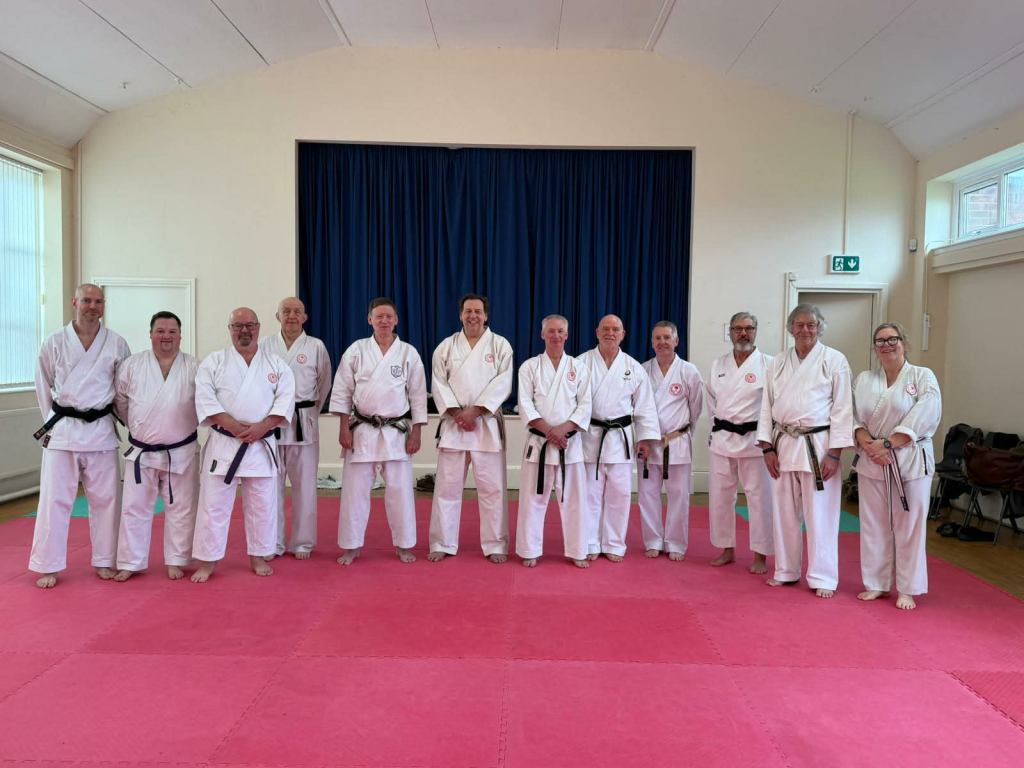
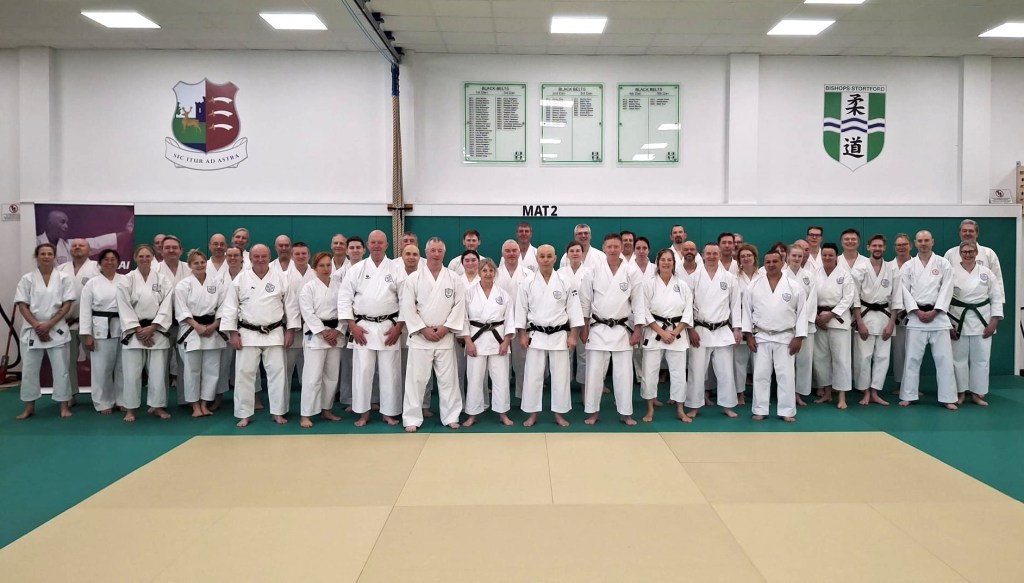
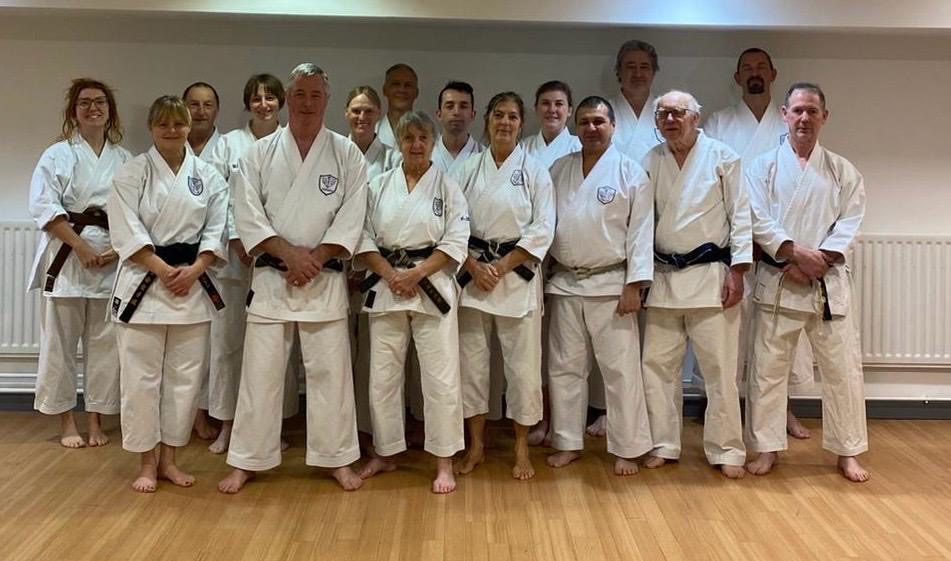
In the second session on Saturday, the group split so that students could practise paired kumite techniques appropriate to their grades. The final session was a moving tribute to our dear friend and fellow karateka, the late Tim Dixon, who sadly passed away in 2023. Tim’s favourite party piece at Shikukai gatherings was always to sing “Great Balls of Fire” and so everyone paired up and delivered Gyakuzuki one for one, without stopping and with Ki-ai throughout the entirety of the song (3 minutes!) Once training was finished and the obligatory group photo was taken, many of us headed to what used to be a pub called The Bear, and is now an Italian restaurant called La Vecchia Orsa (look it up on Google Translate se non parli Italiano). There we enjoyed pizza, birra, wine, pasta, bruschetta, wine, tiramisu and possibly a bit more wine, before heading off to the nearby Waverley Pub to round off an enjoyable and educational first day of the course.
On Sunday, the first training session was led by Sugasawa Sensei. After a short but necessary reminder of how to make a fist in the correct way (with the thumb over the index and part of the middle fingers), this session focused on the concept of Koshi wo Kiru, which is the hip/core movement used to generate energy for techniques. Sensei emphasised that this movement is different from the movement used to initiate turns, or Mawasu. While Kiru is smaller in terms of the range of movement it produces, it is much more concentrated and forceful. Sensei also explained the connection between breathing, Kiru and the all-important Hikite movement, which balances the action of the striking hand and is therefore a key ingredient in making techniques sharp and fast (as demonstrated by Sensei Gary Ockwell).
The second part of Sunday’s training again saw the group split into Dan grades, brown belts and lower kyu grades. The Dan grades initially practiced Jion kata under the guidance of Sensei Pam Rawson. Her take-home message was that although most of the individual movements in Jion are also present in more junior katas and should therefore not be especially challenging to students at this level, there are nevertheless many fine points to remember and many opportunities for students to demonstrate understanding of the Kiru, Hikite and Okori Taru Tokoro principles discussed in the rest of the course. Meanwhile, the brown belts received instruction in Kushanku from Sensei Steve Rawson while Sugasawa Sensei supervised the junior kyu grades. Always best to correct bad habits before they take hold!
For the last part of Sunday’s training, Sensei continued to work with the junior kyu grades while the brown belts joined the Dan grades for a session with Senseis Pam and Steve Rawson. This session focused on Kihon Kumite, with Pam and Steve demonstrating a sequence of nine paired attacks and defences based on parts of the 10 Kihons. Whilst we often perform the Kihons in full when training – as Steve Sensei noted, they take an afternoon to learn and a lifetime to master – it is sometimes beneficial to break out of this routine and look at each move as a component that can be modified and used in different ways.
At the end of the course, Sensei officially presented Archie Warren and Lewis Higginson (Weymouth Ken Bu Jyuku) with their certificates for the 1st Dan grades they obtained at the May course.
A kyu grading was also held in which all three students passed, with Edward Wong receiving 2nd kyu while Kelly Cavaciuti and Jenny Clarke both received 4th kyu. Congratulations to all for a successful end to a very enjoyable course!
Travelling on Friday 10th October to Eindhoven, I had to pinch myself; no queues at Stansted, no queue at the gate and on the plane, and settled in my seat 40 mins before take-off, which happened ahead of time. Ryanair, what is going on?
Add to that, I luckily ended up sat next to a most interesting chap with some very entertaining anecdotes; so, the wheels were touching down before I even blinked. What can possibly go wrong?…. Answer; nothing. The weekend ran like a dream, thanks in large parts to Martijn and Astrid De Vries Schelen, who pulled everything together perfectly.
Friday training.
Responding to requests from my hosts, the content of the training on the Friday evening consisted of core techniques and Wado principles, all leading to Ohyo Henka Dosa. I had introduced this training on a previous course and it was clear that the regulars wanted to dig into this further. This is training that leads into free-form movement by controllable increments, which are essential to establish the rules and prevents the practice degrading into a free-for-all.
Saturday training.
I wanted to hold over to the Saturday a few words I felt were necessary to be said to offer our heartfelt commiserations and sympathies for those affected by the recent passing of KBN Wado stalwart, Gertjan Martens. I had met him on many occasions and attest to the fact that Gertjan always set a solid example of a dedicated Budoka and had touched the lives of all who knew him. A very sad and profound loss.
Content.
Earlier, I had introduced the theme I wanted to explore across the weekend. I presented a physical example of the Sphere and the Cube. I used these to examine the dichotomy of the qualities of fluid movement and solid form. I kept coming back to this, particularly through the paired kata.
I also took this opportunity to share with the Dutch students the most recent updates from Sugasawa Sensei; not ‘changes’ but instead more granular explorations of aspects embedded in the kata.
We did some work on the concept that ‘attack and defence are not just interchangeable but one and the same’. This came through nagashizuki and then working it with a partner.
Social opportunities.
It was really good to have the chance to talk to people outside of the Dojo setting. This time we were booked into a rather excellent Greek style Mediterranean cuisine restaurant, where the staff just kept rolling out delicacy after delicacy (I must get round to giving them a glowing review on TripAdvisor). Great to catch up, and the conversations were not primarily about karate.
Sunday training.
For this day I had a few agenda items lined up, with specific focus on prospective Dan grading candidates (I had previously shared a bunch of notes I had put together, based upon the numerous Dan panels I had sat upon; intended to avoid the typical pitfalls). Part of this was an emphasis on the sometimes-troublesome Kihon Gumite Sanbonme. It’s all in the timing. To get this across I had to detour into physics. While not my strong point, I thought it was necessary to get the point across.
Missing from this time was solo kata training, but the plan is to factor that in for my next visit early in 2026.
As is usual on these courses, I am always running dangerously close to over-planning, but we did manage to get such a lot in, fortunately the logic was all held together by the Sphere and the Cube.
In conclusion; these courses always provide a superb opportunity for like-minded people to get together and reinforce the special bond in the Shikukai family. Add to that the openness that Martijn and Astrid show in inviting the wider Wado community in the Netherlands, who seem to enjoy the opportunity of working shoulder to shoulder with other Wadoka, regardless of their affiliations.
The Kenkokai team always appreciate the presence of other Wado students from further afield. Any Brits who fancy a trip across next time, contact Martijn or myself and we can make it happen.
At the time of writing this I am preparing a set of support notes to reinforce some of the ideas explored over the weekend (including the physics). This will be published on Substack; web address: www.budojourneyman.substack.com
Keep an eye on the Shikukai calendar for the next course in 2026.
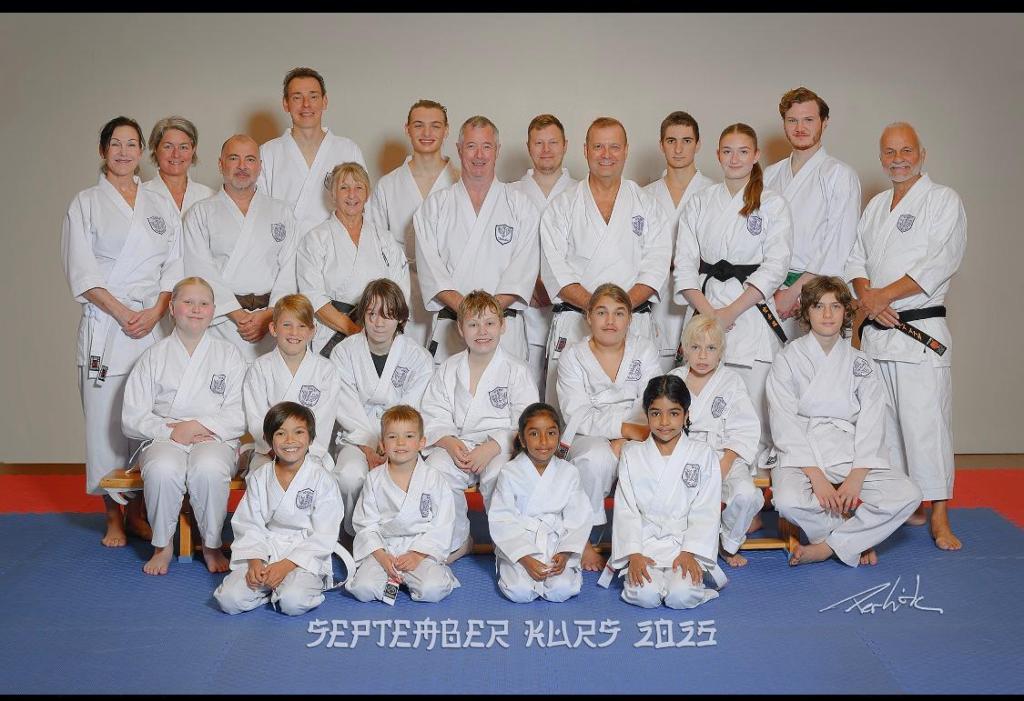
As I drove to our ‘local’ airport to collect the Rawson Senseis for their annual instructing weekend of Norway’s Hoku Sei Jyuku, I was hoping that the weather forecasts were wrong and our recent warm and sunny spell would continue. Alas, we would not be quite that lucky but it was positively Caribbean compared to last year when the course (in November) had to be quickly adjusted due to heavy snow and ‘difficult’ driving conditions. All was not lost then though, as those who could make it from the adult contingent of the club were able to enjoy a reduced training schedule in my home dojo, the Denshinkan; with the curtailed weekend ending with Marianne Vik Wymer gaining her Shodan under the local assessment of the Rawsons and our Association’s Chief Instructor via Zoom. Congratulations Marianne! This year’s more appropriately timed September course ran more smoothly with us securing the exclusive use of our routine training location, the local community hall (Grendahus) for the duration, and our routine Thursday night matted sessions allowing us to set up for the weekend. We have a fairly consistent 10:00-14:00 Saturday and 12:00-15:00 Sunday routine for these courses and when in the Grendahus, any timing overruns are not an issue. The first 1.5 hours of the Saturday is for juniors and in this case a dad also, from a parent and junior class (see image and please note that his youngest son in the picture whilst not yet age appropriate to join his brothers to train, just had to have a gi…).
The junior session is always a more light hearted event, with the aim of encouraging participation and issuing praise when students do their best. Marianne and I were on hand when individual needs required some management but all attendees enjoyed the full group instruction where Pam and Steve covered a number of basics (some of which would appear later for the adults) and a period featuring a 1-to-1 punching and kicking speed competition. Then the group was split into Kihon kata instruction under Sensei Steve and Pinan Nidan instruction under Sensei Pam.
All performed well and enjoyed the experience as can be seen by the photographs, mostly taken by our resident professional photographer, Per. For the reader that is unaware, Per is the senior, white haired gentlemen on the right of the group image whose face does not appear to have changed in any picture he has produced over the last 10 years… The adult session was soon enough upon us and it was not long before we were all enjoying the Rawson basics drills that the juniors had experienced. The drills were focussed on basic stances with repeating stance changes aimed at reenforcing the transition requirements, as well as understanding what the body is required to do to maintain and get into the stances, properly.
The remainder of the session introduced a movement sequence drill aimed at the body moving smoothly and under control, followed by a period of pair work activity where Sen No Sen was explained, in particular the technical and timing requirements and how they differ to Go No Sen and Sente. Saturday evening saw the routine social gathering at the Wymer household and apart from there being too much food and a family ‘taxi’ slipping off the road next to the Denshinkan, the evening can rightly be described as a successful one. Of course, no pending birthdays were discussed, although a couple of gift presentations were made and there was a rendition of Happy Birthday Norwegian style, should their relevance appear at any time. Sunday’s session was planned to start at 12:00, which it did for most… Isn’t Seiza a wonderful reminder of the need to be punctual? This session was a real mixed bag as was the plan. The instructing Senseis repeated and built upon some of the basic stance transition instruction from the Saturday session, with a number of the students commenting on the importance of understanding the Hiki hand, almost as if it has never been mentioned before! We then moved onto Jitte Kata for a period before the Senseis introduced a 12 move pair work sequence, teaching 3 moves to each of the attending 4 pairs. The pairs then passed on their moves to each adjoining pair, building up to the final sequence where everybody went through the full sequence, carefully. The session closed all too quickly (despite the 1/2 hour overrun) after a demonstration of kneeling defence (Idori 1,2 and 7) and a brief walkthrough / talk through of knife defence (Tanto Dori). This was yet another very enjoyable weekend under the experienced instruction of Pam and Steve Rawson, 7th Dan Senseis. Their repeated visits to Norway are always welcomed and if any member of the Shikukai Association would like to join them on their next visit or perhaps on another occasion, don’t hesitate to make contact. Bob Wymer 5th Dan Hoku Sei Jyuku
‘How am I benefitting from this?’ ‘What am I getting from this?’
This was the theme that ran in the background of the seminar delivered by Tim Shaw 7th Dan Sensei, (The Budo Journeyman), hosted by Andrew Genery Sensei and Kishinkai Wado Ryu.
Sensei promised 2 deep dives:
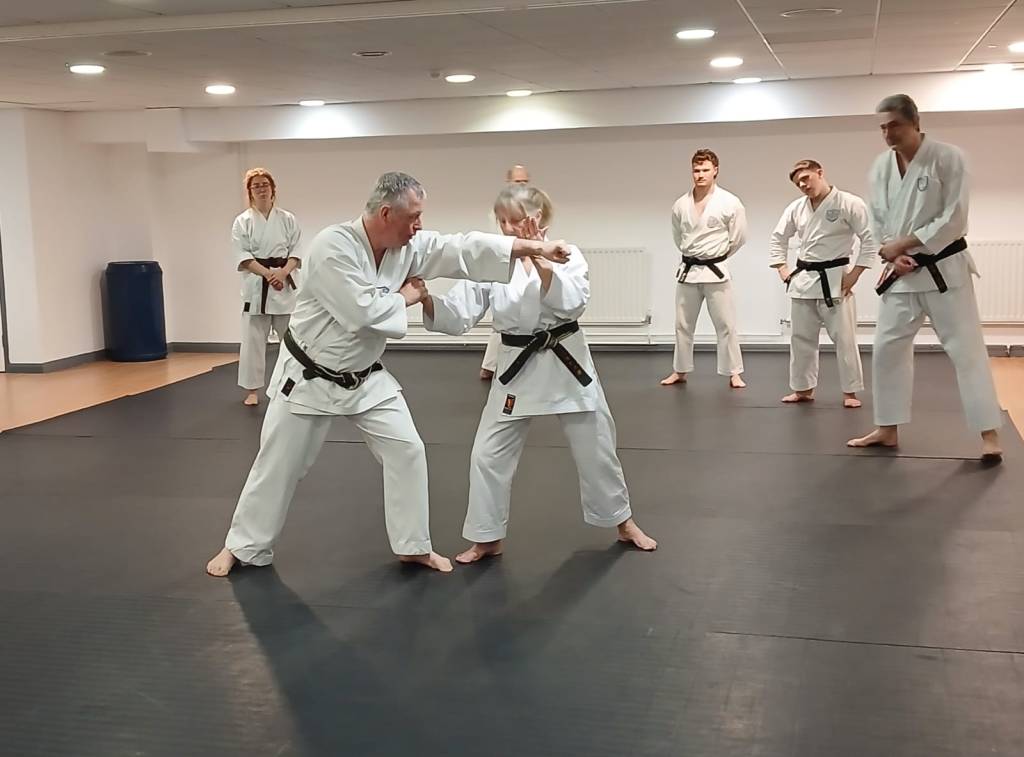
(1) Wado Ryu basics Junzuki and Junzuki No Tsukkomi, moving on to the Wado Ryu staple, Nagashizuki. This was tied in with the end of Pinan Nidan and using body rotation as a revolving door. The key principles of Meoto te and Kobo no Ichi were highlighted while performing Nagashizuki.
(2) Pinan Sandan – each part of the kata was broken down and investigated to understand the key principles.
Thanks to Tim for making the journey north to share his vast depth of knowledge. Watch this space for next time!









 Shikukai Karate-Do International